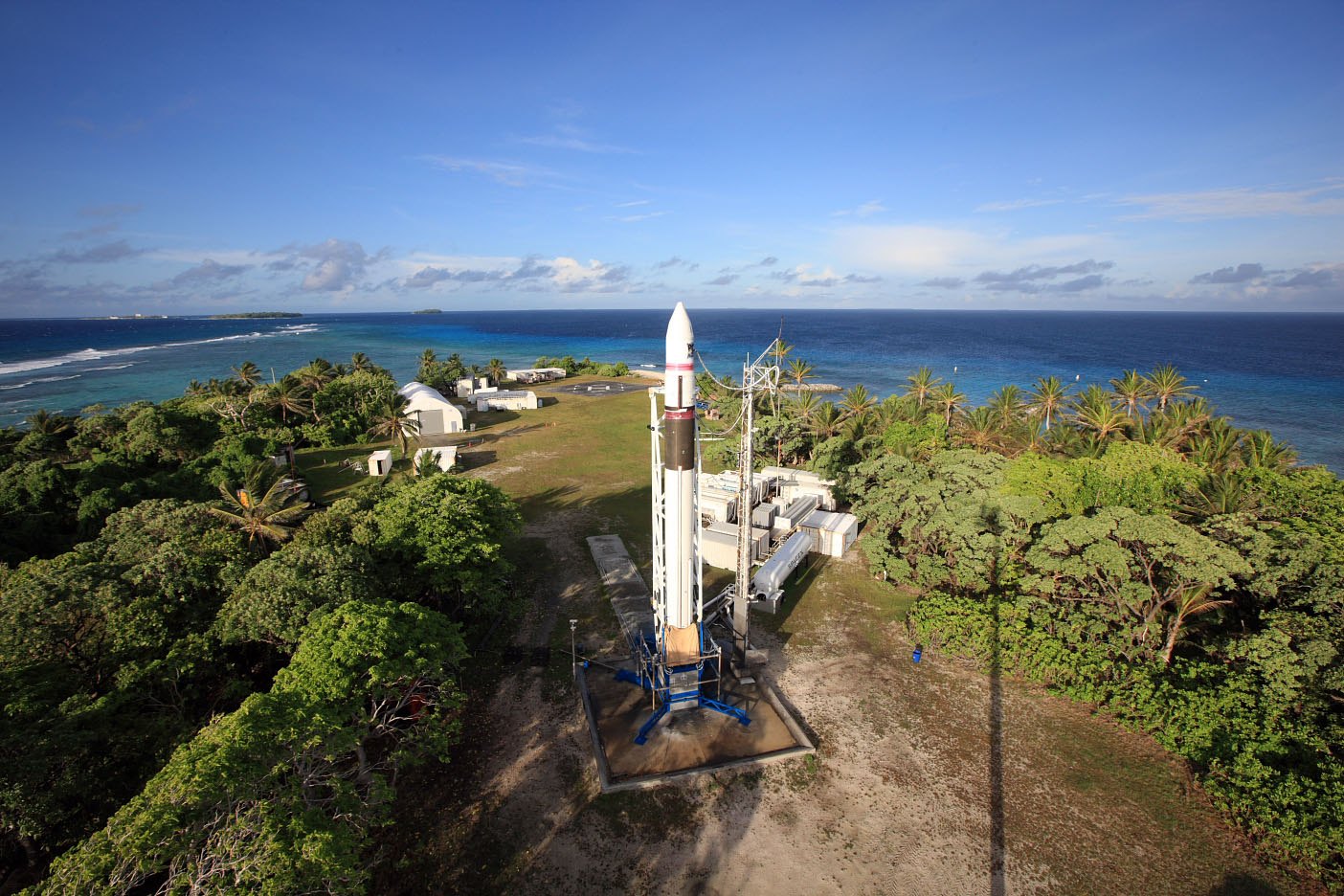
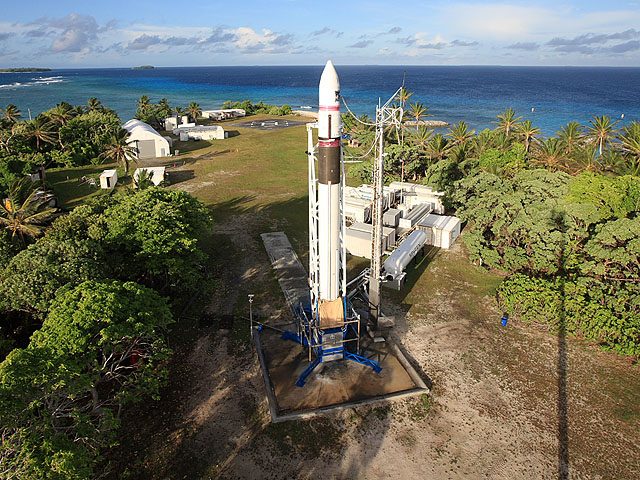
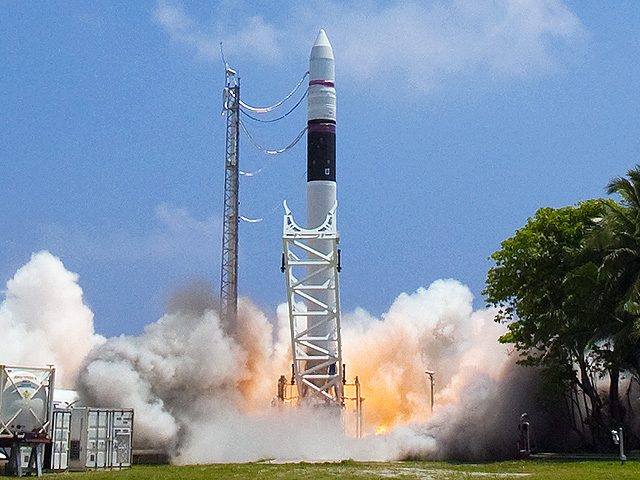
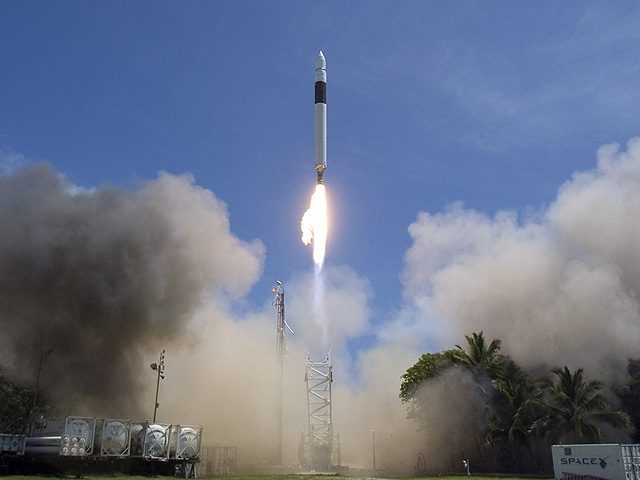
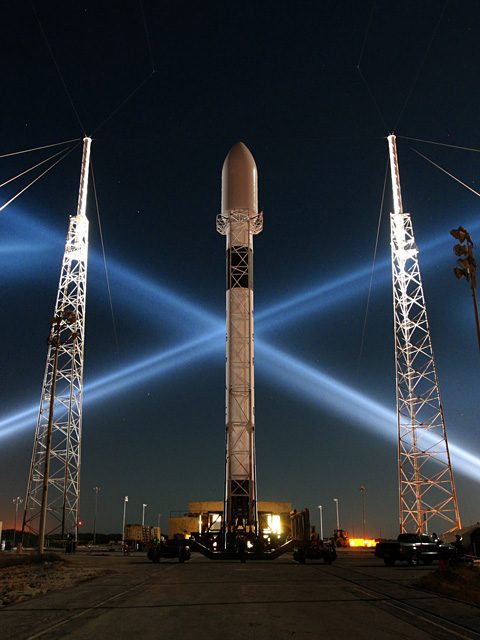
Falcon 1 on its pad on Omelek Island, in the Kwajalein Atoll. This is the Flight 4 rocket, in September 2008; Flight 3 stood in the same place.Photo: SpaceX, 2008 media kit
August 2, 2008
Day 0
Two Falcon 1 rockets had failed. On August 2, 2008, SpaceX gathered everyone in the hangar to watch the third. This room follows the next 161 days, in order, as they happened.
Act one: the last attempt
Day 0 to Day 57
1
August 2
2:15 p.m.
Flight 3 stood on its pad on Omelek Island, in the Kwajalein Atoll, 2,500 miles southwest of Hawaii. The launch window opened at 4 p.m. California time.
2:15p.m.California time
2:15 p.m., Kimbal Musk’s blog
Falcon 1 Launch window opens in two hours
The launch window will open at 4:00 p.m. (PDT) / 7:00 p.m. (EDT) / 23:00 (UTC) and remain open for five hours.
Webcast url is now available: http://www.spacex.com/webcast.php
Kimbal Musk blogged the launch from the Hawthorne hangar. Each post here appears at the time he wrote it.
2
August 2
4:54 p.m.
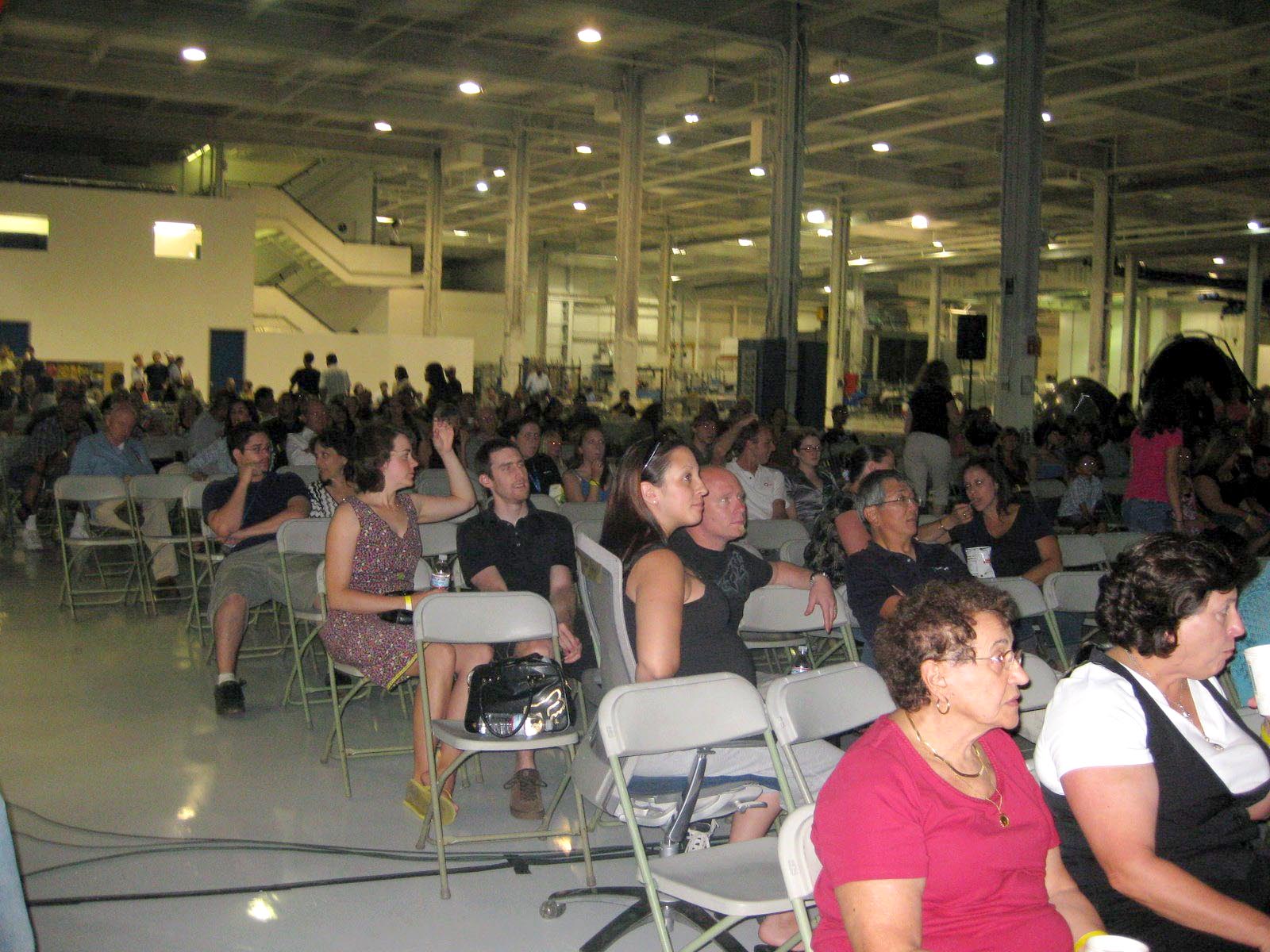
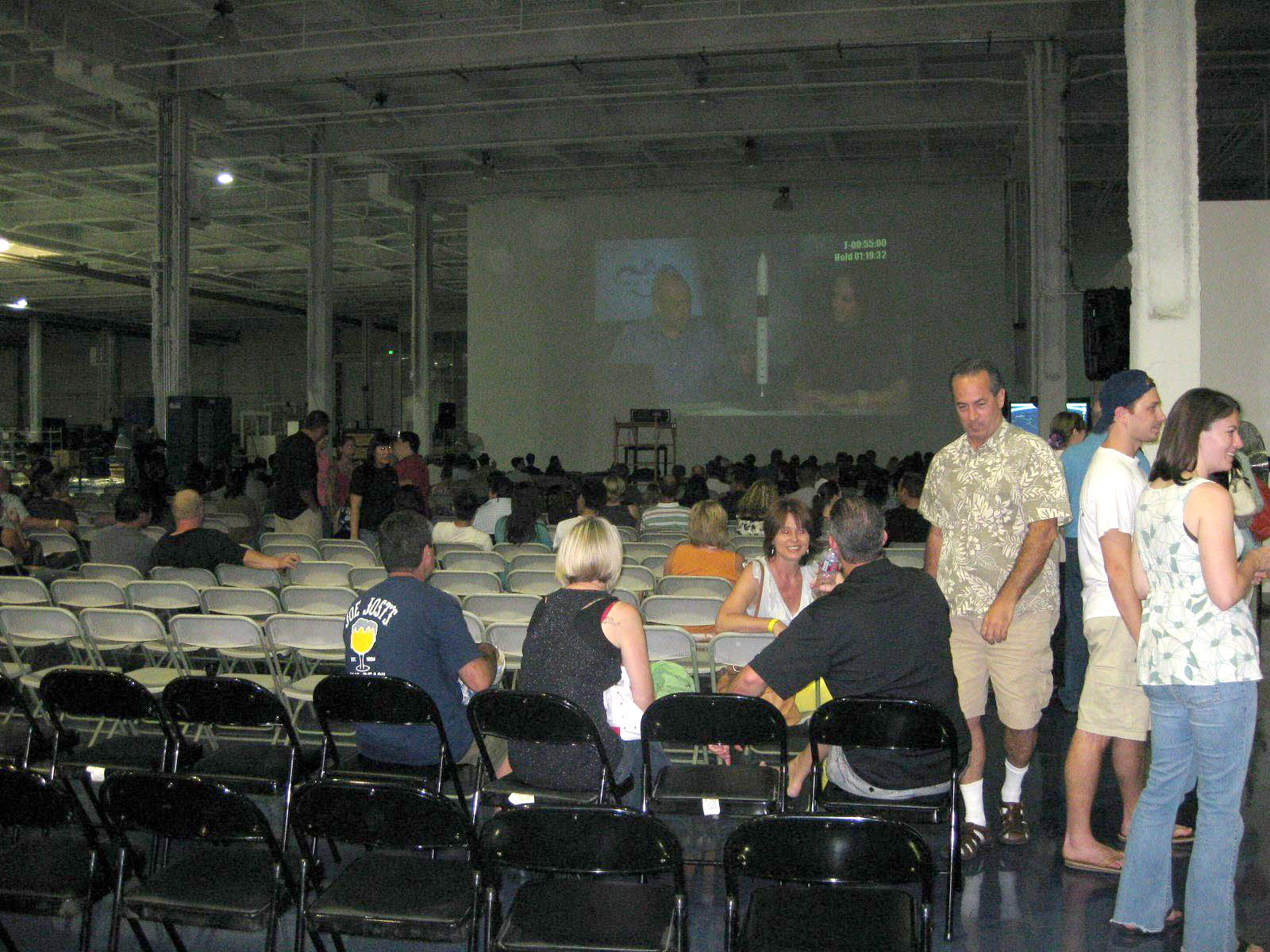
Staff and families in the Hawthorne hangar.Photo: SpaceX, from Kimbal Musk’s blog“The webcast in IMAX 3D! (just kidding)”Photo: SpaceX, from Kimbal Musk’s blog
Kimbal Musk’s blog, 4:54 p.m.August 2, 2008
SpaceX crew in Hawthorne
SpaceX’s headquarters in Hawthorne, CA. The entire staff and their families are viewing the webcast in the Hanger.
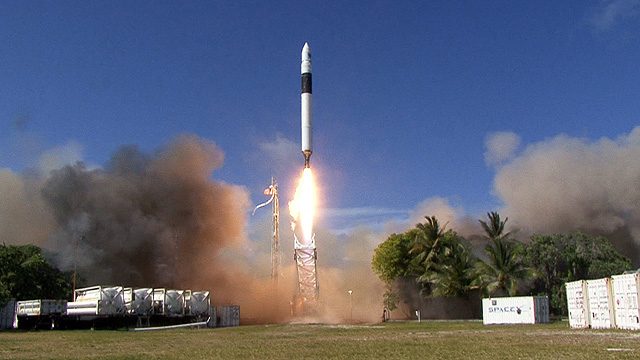
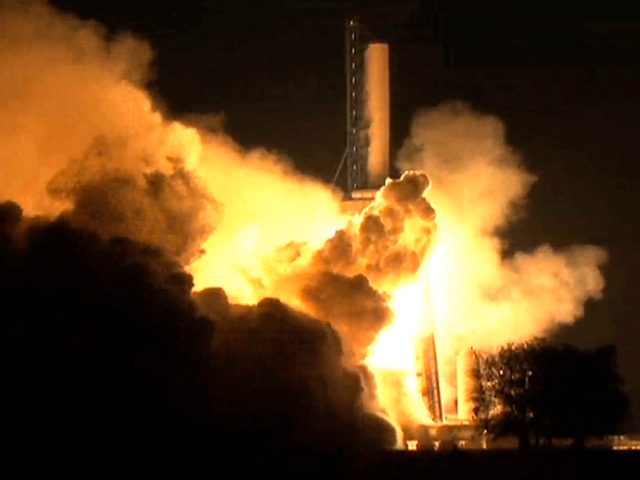
Falcon 1, Flight 3: liftoff and the failure. The webcast’s own sound plays in YouTube’s player.SpaceX webcast, August 2, 2008. Uploaded by Spacevidcast. Watch it on YouTube
8:38 p.m., Kimbal Musk’s blog
Anomoly in launch
Waiting for more information.
We have two more Falcon 1’s right behind this one, no matter what happened.
The first stage flew perfectly. At separation it bumped the second stage, and the rocket tumbled. Four minutes later Kimbal posted the line this room turns on.
“So when we lost video, we knew something had gone wrong in a big way.”
Dolly Singh, head of recruiting. Quora, 2013.
5
August 2
The same night
Three of three had failed. The company waited to hear what Musk would do.
Elon Musk to every employeeAugust 2, 2008
“For my part, I will never give up and I mean never.”
Plan Going Forward
The most important message I’d like to send right now is that SpaceX will not skip a beat in execution going forward. We have flight four of Falcon 1 almost ready for flight and flight five right behind that. I have also given the go ahead to begin fabrication of flight six.
There should be absolutely zero question that SpaceX will prevail in reaching orbit and demonstrating reliable space transport. For my part, I will never give up and I mean never.
Musk said it to the company on the factory floor, then wrote it down. He named flights four, five and six, and approved parts for the sixth.
“When Elon came out, he walked past the press and first addressed the company.” … “I think most of us would have followed him into the gates of hell carrying suntan oil after that.”
Dolly Singh, head of recruiting. Quora, 2013.
6
How much money was left?
Under everything was one question: how many more tries could SpaceX pay for?
The record
Elon Musk to every employeeAugust 2, 2008
Plan Going Forward
As a precautionary measure to guard against the possibility of flight 3 not reaching orbit, SpaceX recently accepted a significant investment. Combined with our existing cash reserves, that ensures we will have more than sufficient funding on hand to continue launching Falcon 1 and develop Falcon 9 and Dragon.
The $20 million from Founders Fund is announced on Day 2.
SpaceX press releaseAugust 4, 2008
SpaceX Receives $20 Million Investment from Founders Fund
SpaceX, a privately-held space launch services provider, has received a $20 million equity investment from Founders Fund, a leading technology venture capital firm, headquartered in San Francisco.
“If that fourth launch hadn’t worked, that would have been it. We would have not had the resources to mount a fifth.”
Elon Musk, CEO and CTO. 60 Minutes, 2012.
“I figured we could pull a fifth launch off, but that was it. … I thought we could get to five. He thought four was it.”
Gwynne Shotwell, vice president of business development. Stanford GSB, 2022.
On what Musk told the factory that night: a significant investment gave SpaceX
“ample financial resources to attempt 2 more launches; giving us security until at least flight 5”
Dolly Singh, head of recruiting. Quora, 2013.
She recalls the investor as Draper Fisher Jurvetson; the record says Founders Fund.
The books
“Flight four was it.”
Vance, Elon Musk, ch. 8
Musk had about $30 million left. The payroll had passed 500 people.
Berger, Liftoff, ch. 11
That night Musk told staff the money was enough. He kept the company confident. Years later he said one more failure would have ended SpaceX. Shotwell thought they could fly a fifth.
The back of the envelope
$30 million sounds like a lot. But it was Musk’s own money, the last of it, and he split it between SpaceX and Tesla (Berger). SpaceX had more than 500 people and almost no revenue. At about $130,000 a year per person, salary plus benefits and overhead, payroll alone burns about $5.4 million a month.
Half of $30 million covers less than three months of it, before one part, one test or one launch is paid for. Add Founders Fund’s $20 million and it is still only about six months. Shotwell, looking ahead, saw payroll fail within six to eight weeks (Berger, Liftoff, ch. 11).
Half of $30 million $15.0 million. About 2.8 months. Out in late October.
Aug
Sep
Oct
Nov
Dec
Jan
Feb
With Founders Fund’s $20 million $35.0 million. About 6.5 months. Out in mid February.
Aug
Sep
Oct
Nov
Dec
Jan
Feb
Musk’s money, half of $30 millionFounders Fund, $20 millionEach line is $100,000. Each stack is one month of payroll, 54 lines.
500 people × $130,000 ÷ 12 = about $5.4 million a month. Explorist’s estimate, not a SpaceX figure.
7
August 3
Day 1
Eight weeks
The next day, Musk called his senior team together, with the launch crew on Kwajalein on the phone.
Wired
August 5, 2008
Now 0-for-3, SpaceX’s Elon Musk Vows to Make Orbit
By Carl Hoffman
The third time was definitely not a charm for SpaceX.
Wired.com: How do you maintain your optimism?
Musk: Do I sound optimistic?
Wired.com: Yeah, you always do.
Musk: Optimism, pessimism, fuck that; we’re going to make it happen. As God is my bloody witness, I’m hell-bent on making it work.
The press counted the failures. Inside, the team expected blame. Musk gave them a deadline instead: build the last rocket from parts in the factory, and fly it in eight weeks.
“I thought, I’m not even gonna be able to get home. Like, where am I gonna scratch up $1,800 to fly back to the States?” … “Elon said, can scrounge up enough, and you guys have eight weeks to launch the next rocket, whereas we had previously done that in a year.”
Tim Buzza, launch director, stranded on Kwajalein. It’s Not Rocket Science, 2026.
“I was frustrated and almost giving up at that time, and he was just the opposite.”
Hans Koenigsmann, vice president of launch. It’s Not Rocket Science, 2026.
He calls what followed “a Hail Mary with that rocket”.
The meeting was in the Von Braun room, with Kwaj on the line.
Engineers spent the weekend in the flight data. On Wednesday, SpaceX published what they found.
SpaceX mailing listAugust 6, 2008
Falcon 1, Flight 3 Mission Summary
The problem arose due to the longer thrust decay transient of our new Merlin 1C regeneratively cooled engine, as compared to the prior flight that used our old Merlin 1A ablatively cooled engine.
We were aware of and had allowed for a thrust transient, but did not expect it to last that long. As it turned out, a very small increase in the time between commanding main engine shutdown and stage separation would have been enough to save the mission.
Read the whole summaryDrawn by Explorist from the mission summary’s explanation. Not to scale.
The new Merlin engine kept pushing for about a second after shutdown. In the vacuum of space, that was enough to push the spent stage back into the second. The fix: wait longer before separating.
“We made one change with the rocket engine. We missed one change in a separation timing.”
Tim Buzza, launch director. It’s Not Rocket Science, 2026.
Steve Davis found it overnight.
Berger, Liftoff, ch. 8
9
August
RatSat
Flight 4 had a rocket. It still needed something to carry.
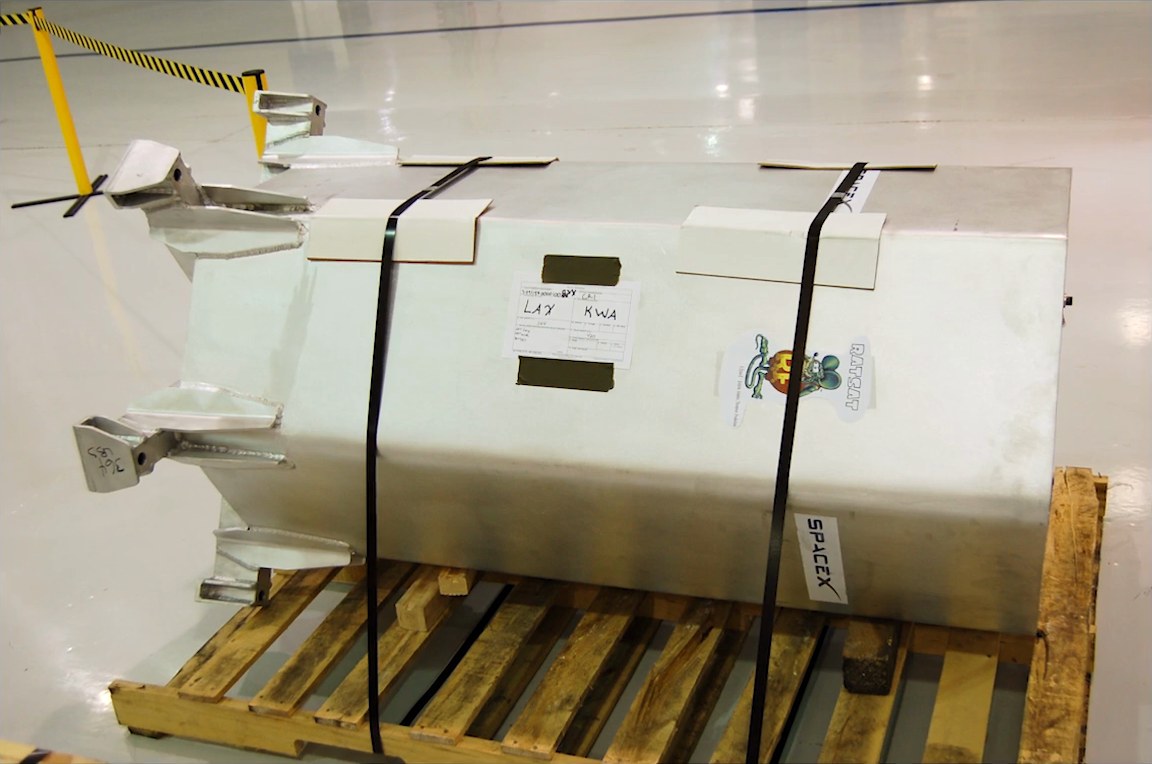
Malaysia would not risk its satellite on this rocket. Three engineers built a 364-pound aluminum dummy in under a week and named it from their initials.
Berger, Liftoff, ch. 9
No customer would fly on Flight 4. So the payload was a block of aluminum, built in a week.
“RatSat,” an aluminum box strapped to a pallet.Photo: SpaceX, “Falcon 1, Flight 4”
10
September 3
Day 32
The C-17
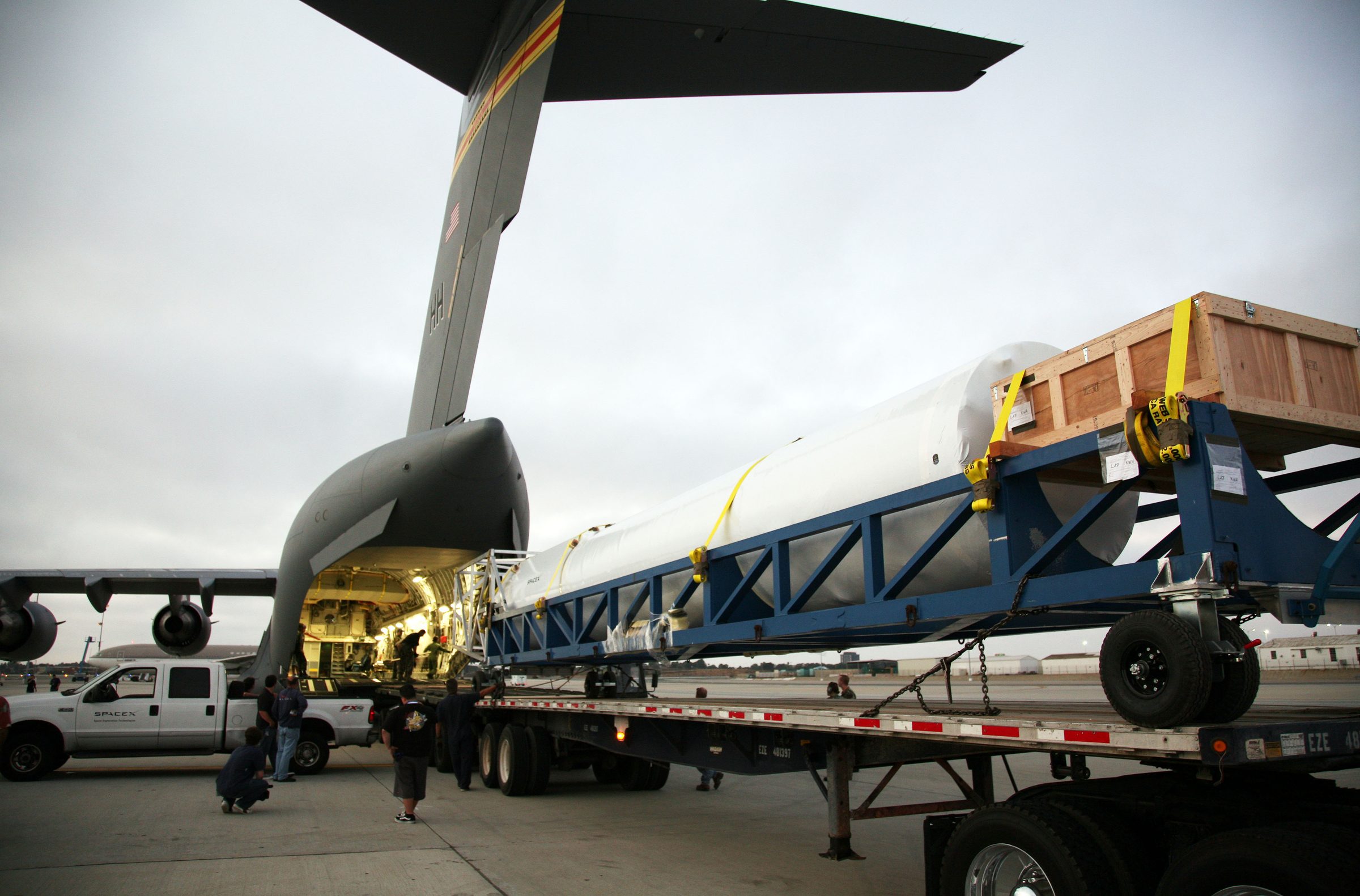
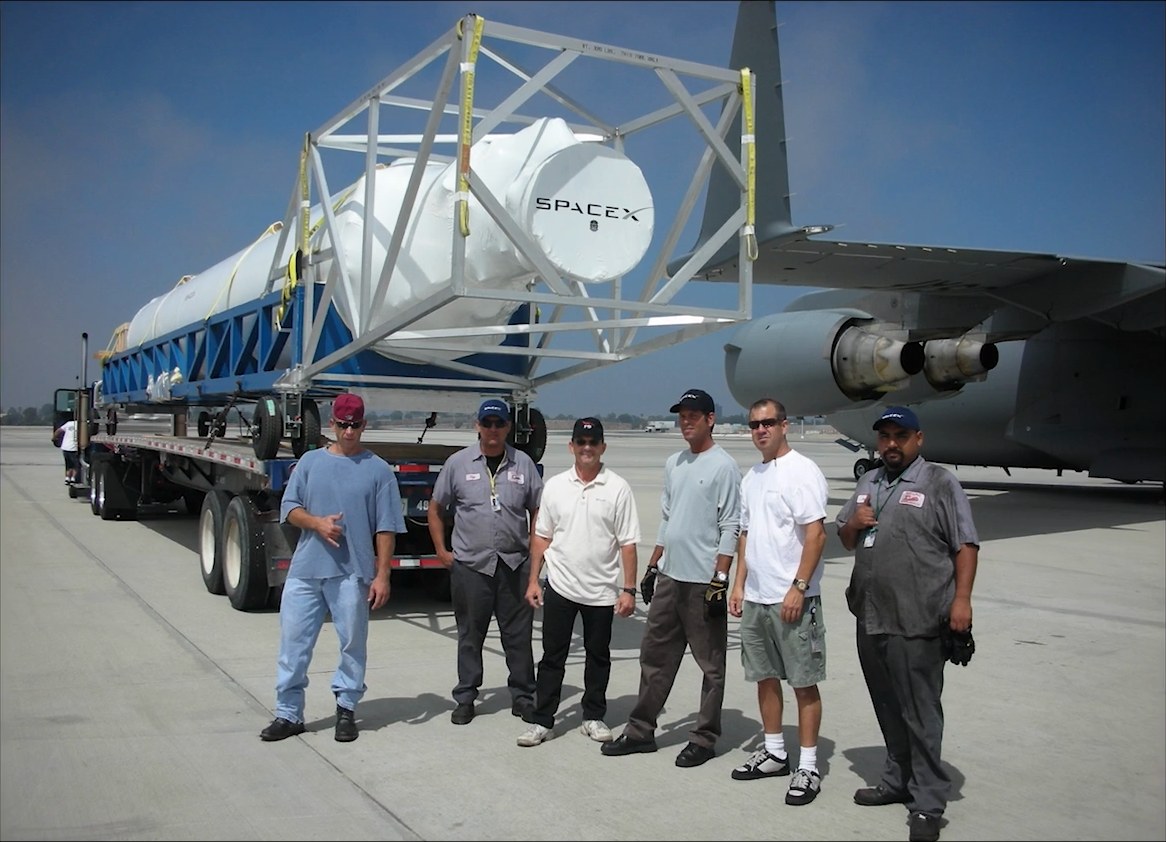
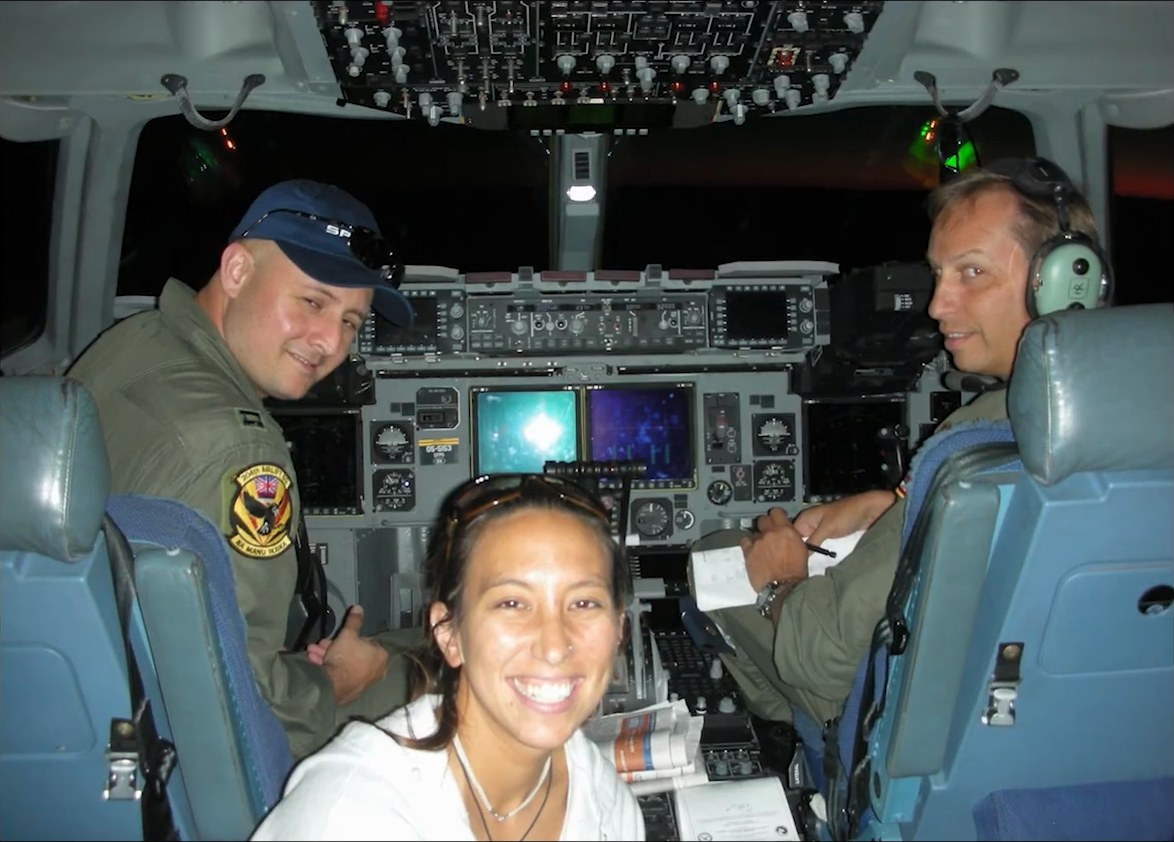
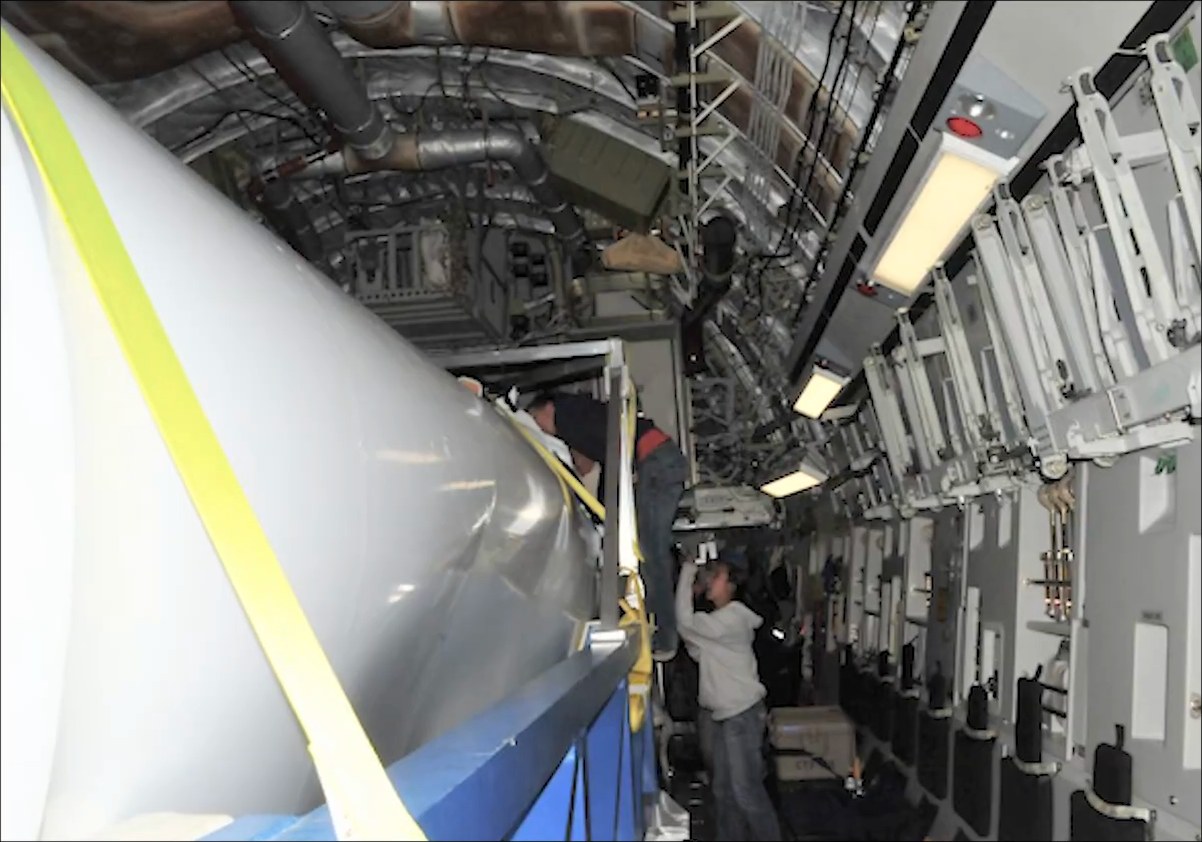
The rocket for Flight 4 was ready in about a month. To save time, SpaceX hired a US Air Force C-17 to fly it from Los Angeles to Kwajalein.
The Flight 4 rocket goes into the C-17.Photo: SpaceX, 2008 media kit
The crew with the rocket on its trailer, beside the C-17.Photo: SpaceX, “Falcon 1, Flight 4”Flo Li in the C-17’s cockpit with the aircrew.Photo: SpaceX, “Falcon 1, Flight 4”
SpaceX, Flight 4 launch updatesSeptember 19, 2008
Expedited delivery — SpaceX purchased a C-17 flight from the USAF to fly the Falcon 1 Flight 4 vehicle from Los Angeles International to the Kwajalein Atoll
The record says only “expedited delivery.” The people on board remember the last rocket crushing itself over the Pacific, and ten minutes to save it with a wrench.
“On the approach, you could see Hawaii and so on, all of a sudden there were strange noises from the plane.”
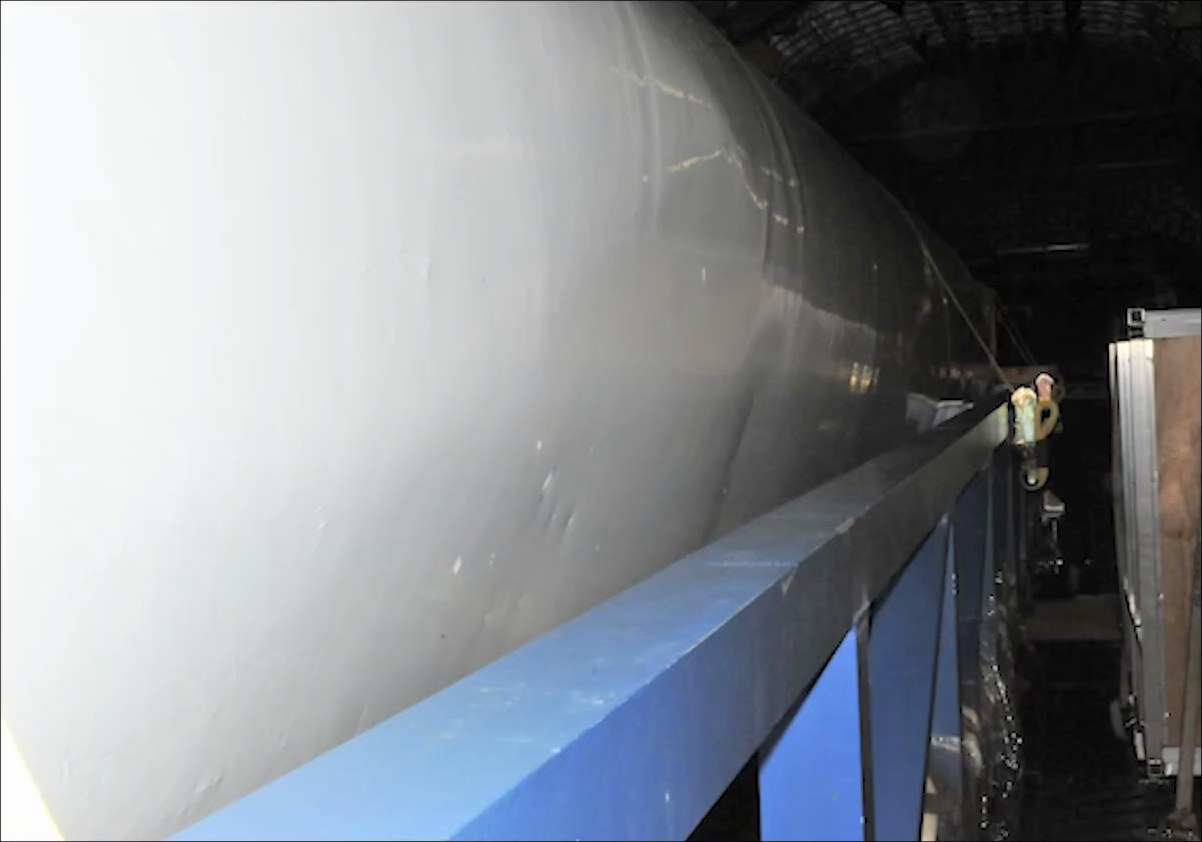
Bulent Altan, avionics lead. Senkrechtstarter interview, translated from German, 2021.The first stage in the C-17’s hold, its tank wall crushed inward. Someone climbs in at the top of the stage.Photo: SpaceX, “Falcon 1, Flight 4”
“You could literally see where the cylinder of the rocket had started to suck in and compress like a beer can.”
Zach Dunn, propulsion engineer. Atoms & Bits, 2023.The first stage in the hold.Photo: SpaceX, “Falcon 1, Flight 4”
“The first person I could see was our structural engineer, Florence Li, and she pointed at the rocket, crying.”
Bulent Altan, avionics lead. Senkrechtstarter interview, translated from German, 2021.
The crew asked:
“Do we need to throw it out of the back of the airplane?” … “We said do not throw it out of the back of the airplane.”
Falcon 1, Flight 4, SpaceX’s film. A later account.SpaceX, 2023. Watch it on YouTube
11
September 5 to 12
“Strip it like a Chevy.”
The rocket reached the island with its first stage dented.
“Don’t even tell me what else is wrong with it. Just keep going.”
Tim Buzza, launch director. It’s Not Rocket Science, 2026.
The repair estimate was six weeks. The money did not allow six weeks. The team rebuilt the stage on a coral island in about one.
“I actually think it was Chris Thompson. He said, alright. Knock all that off. Strip it like a Chevy.”
Tim Buzza, launch director. It’s Not Rocket Science, 2026.
The repair estimate was six weeks. Musk went “off the frickin’ deep end.” The team stripped the stage on the island and rebuilt it in about a week, then pressure-tested the dented tank with live propellant.
Berger, Liftoff, ch. 9
12
September 15, 2008
Day 44
The crash
While the team rebuilt the rocket, the world’s banks began to fail.
Lehman Brothers files for bankruptcy on September 15, and the markets seize.
The world outside
Monday morning’s paper. Lehman filed for bankruptcy before the markets opened.Front page: The Wall Street Journal, September 15, 2008
On September 15, Lehman Brothers went bankrupt and the markets froze. The investors SpaceX and Tesla needed stopped writing checks. If more money came, it would come from a customer.
“We had three failures under our belt. So it’s pretty hard to go raise money. The recession is starting to hit. The Tesla financing round that we tried to raise that summer had failed.”
Elon Musk, CEO and CTO. Interview with Berger, in Liftoff, ch. 9, 2021.
And on Tesla’s investors:
“Try to imagine explaining that you’re investing in an electric car company, and everything you read about the car company sounds like it is shit and doomed and it’s a recession and no one is buying cars.”
Elon Musk, CEO and CTO. Interview with Vance, in Elon Musk, ch. 7, 2015.
“By the fall, overall economic activity in the country slumped as the U.S. gross domestic product fell by nearly 5 percent.” The money U.S. venture funds raised fell from $53.2 billion in 2008 to $22.7 billion in 2009.
Berger, Liftoff, ch. 10
Kimbal had lost most of his money too.
Isaacson, Elon Musk, ch. 29
Musk “fretted about how his company’s desperate finances must look to NASA as his personal wealth dried up amid the recession.”
Berger, Liftoff, ch. 11
13
September 20 to 23
The static fire
On Omelek, the rebuilt rocket was ready for a static fire: its engine run on the pad, with the rocket held down.
SpaceX mailing listSeptember 23, 2008
Flight 4 on the pad at Omelek, September 2008.Photo: SpaceX, mailing-list update, September 23, 2008
Flight 4 of Falcon 1
The static fire took place on Saturday [20 Sep 2008, CA time], as expected, and no major issues came up. However, after a detailed analysis of data, we decided to replace a component in the 2nd stage engine LOX supply line. There is a good chance we would be ok flying as is, but we are being extremely cautious.
This adds a few extra days to the schedule, so the updated launch window estimate is now Sept 28th through Oct 1st [CA time].
“My husband was sleeping. I’m in the bathroom with the shower on, typing up a proposal for the 1.6-billion-dollar NASA resupply to the International Space Station.”
Gwynne Shotwell, vice president of business development. Stanford GSB, 2022.
In the last hours, three people the outcome hung on were on three continents.
15
September 28
4:13 to 4:36 p.m.Day 57
Orbit
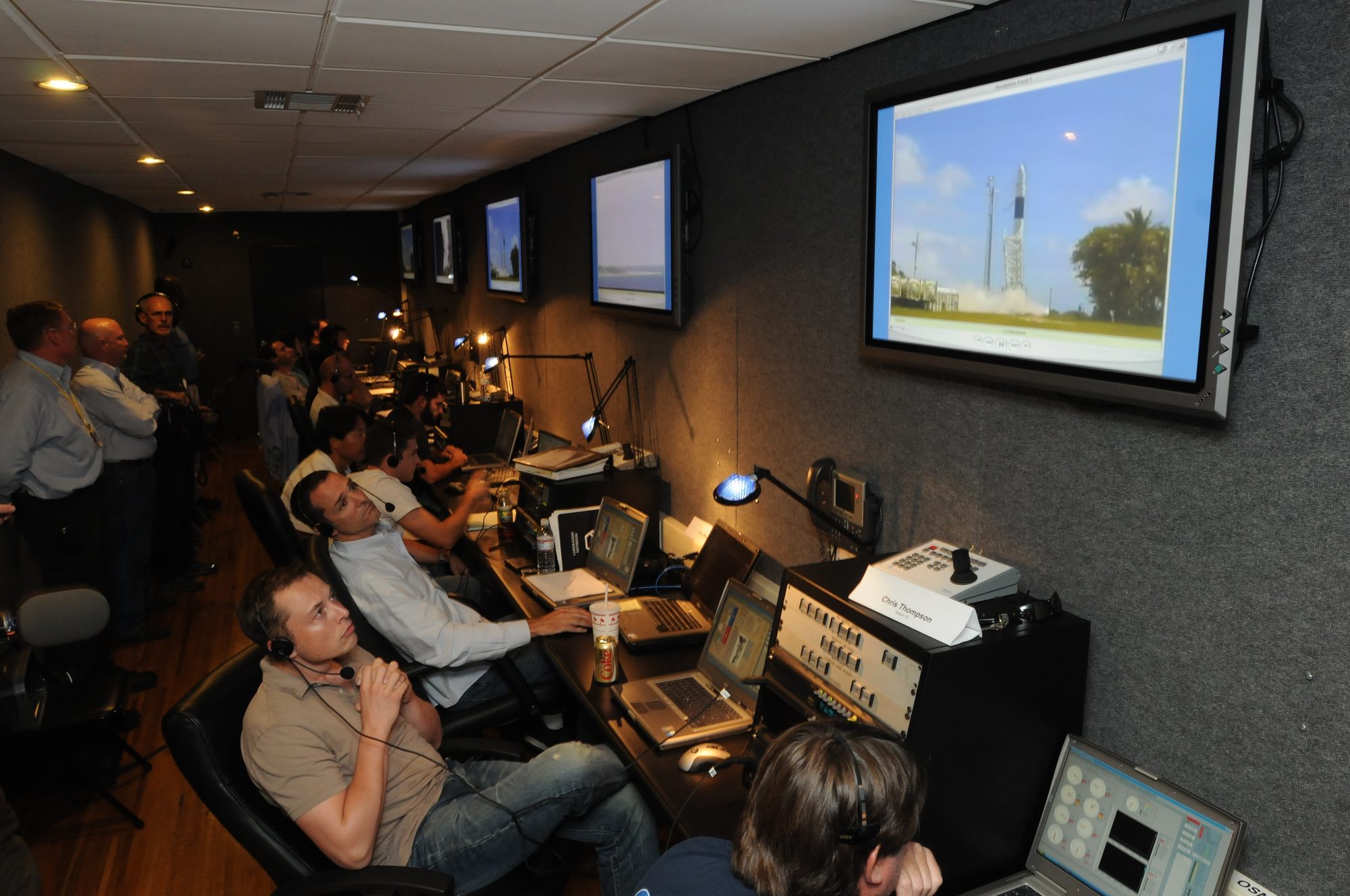
A small team ran the launch from a trailer at the back of the Hawthorne factory. The rest of the company watched the webcast outside.
Elon Musk, Tom Mueller and team watch the launch of the fourth flight of the Falcon 1 rocket in California.Photo: SpaceX, Flight 4 launch updates, September 2008
A reconstruction
Outside the trailer3D reconstruction
Drag to look around
Click the trailer to go in
Screens: SpaceX’s Flight 4 webcast, film and photographs. The room is rebuilt from photographs and shown empty so the equipment can be seen.
4:13p.m.California time
Falcon 1, Flight 4: the webcast. The webcast’s own sound plays in YouTube’s player.SpaceX webcast, September 28, 2008. Watch it on YouTube
Kimbal Musk (@kimbal), 4:13 p.m.
In the control room at Hawthorne. Dead silence as the count hits T-2:30s
Kimbal Musk (@kimbal), 4:15 p.m.
Launch!!!
“We were consistently flying 1.5 degrees to the right of centerline… So flight 4 we offset it preflight and it flew right down the line perfectly.”
Tim Buzza, launch director. Reddit, 2021.
Kimbal Musk (@kimbal), 4:18 p.m.
Come on second stage. Light up baby.
Kimbal Musk (@kimbal), 4:24 p.m.
We’re now orbital. Fuckin’ A.
Shotwell, in Glasgow:
“ran down the hall, knocked on all the doors for my team that was there, and we hugged and kissed and cried.”
Gwynne Shotwell, vice president of business development. Stanford GSB, 2022.
Kimbal Musk (@kimbal), 4:28 p.m.
A perfect launch. Everyone is jumping off their chairs!!!
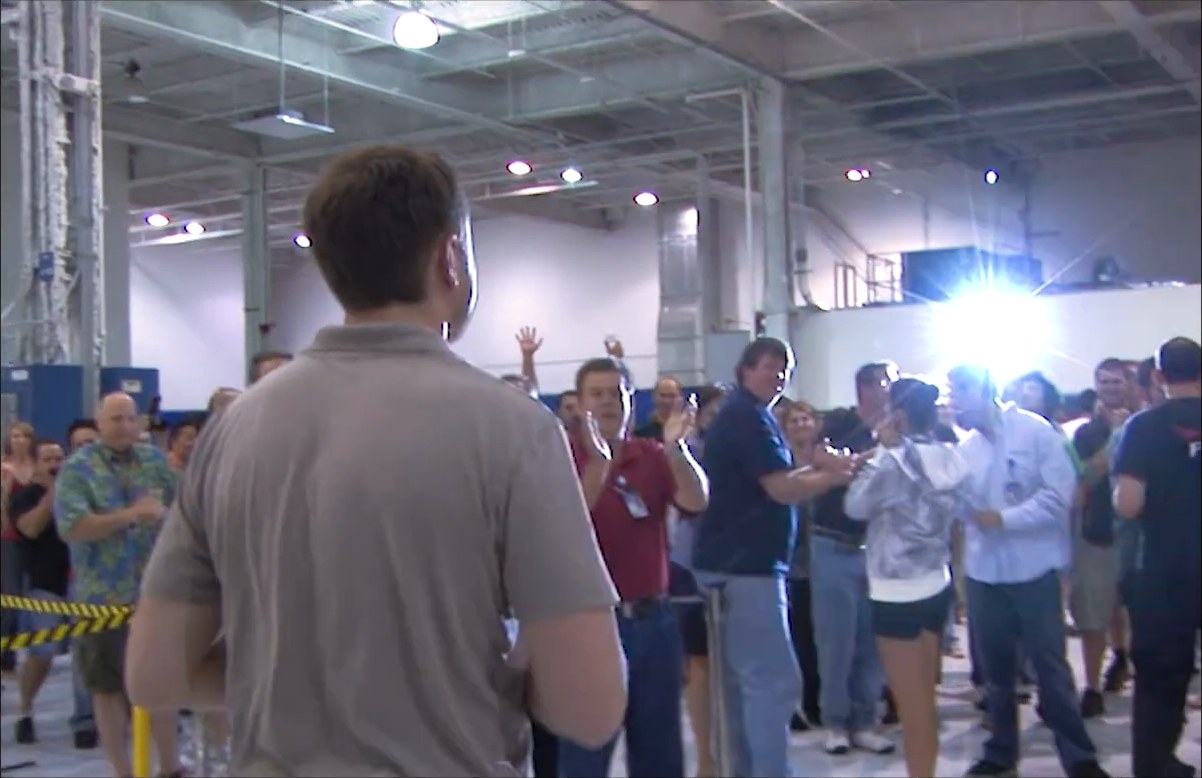
Musk’s speech to the factory floor. The same webcast, from the speech, 32 minutes in.SpaceX webcast, September 28, 2008. Watch it on YouTube
Kimbal Musk (@kimbal), 4:36 p.m.
Great speech by Elon. The whole company is cheering.
SpaceX mailing listSeptember 28, 2008
Post Launch Statement
Wow, this is a great day for SpaceX and the culmination of an enormous amount of work by a great team. The data shows we achieved a super precise orbit insertion — middle of the bullseye — and then went on to coast and restart the second stage, which was icing on the cake.
I will have a more complete post launch statement tomorrow, as right now I’m in a bit of a daze and need to go celebrate :)
Elon Musk to the company, in the webcastSeptember 28, 2008
Well, that was freaking awesome. We made orbit. … There are a lot of people that thought we couldn’t do it. A lot, actually. But, you know, as the saying goes, fourth time’s the charm, right?
… Definitely this is one of the greatest days of my life, and I think probably for most people here.
Falcon 1 Flight 4 lifted off at 4:15 p.m. California time. Nine and a half minutes later it was the first privately developed liquid-fuel rocket to reach orbit.
16
September 29
The next day
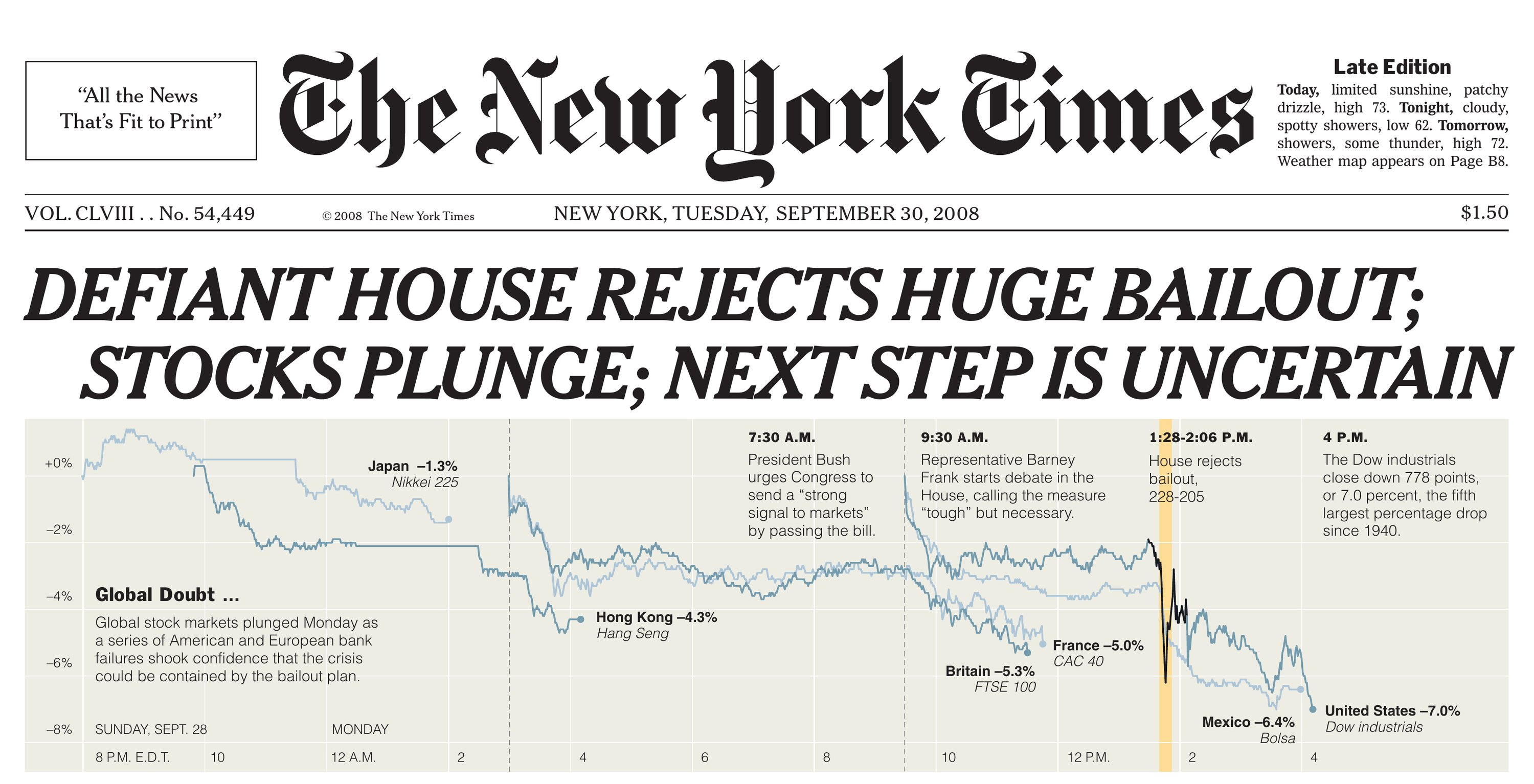
The day after orbit, the House voted down the bailout. The Dow fell 778 points, 7 percent.
The world outside
The chart starts on Sunday evening, September 28, a few hours after Flight 4 reached orbit.Front page: The New York Times, September 30, 2008
17
October 7
Relief
Nine days later, with the flight data reviewed, Musk wrote to the mailing list.
SpaceX mailing listOctober 7, 2008
Flight 4 Launch Update
A week spent reviewing data has confirmed that the flight went really well, including the coast and restart. The mood here at SpaceX is just ecstatic! This is the culmination of six years of hard work by a very talented team. It is also a great relief for me, who led the overall design of the rocket (not a role I expected to have when starting the company).
The company celebrated. Musk remembers relief, not joy. Orbit proved the rocket. It did not pay the payroll.
“That was also with the last bit of money that we had. Thank goodness that happened.”
Elon Musk, CEO and CTO. Caltech commencement, 2012.
Musk felt no joy, only that “the patient survived.” The factory had no rockets, and the only customer left was Malaysia.
Berger, Liftoff, ch. 11
Act two: the sprint
Day 57 to Day 161
18
The turn
Falcon 1 had reached orbit. NASA was about to choose who would carry cargo to the space station.
Elon with fuel tank parts, Hawthorne, October 15, 2008.Photo: Steve Jurvetson
“Musk was desperate for the full-duration test-firing to occur before NASA reached a decision on contracts.”
Berger, Reentry, ch. 1
19
November 22
10:30 p.m. Central
Nine engines
Falcon 9’s first stage had nine Merlin engines where Falcon 1 had one. At the test stand in McGregor, Texas, SpaceX had to show that all nine could fire together for a whole flight.
All nine engines for 178 seconds, a full first-stage burn.SpaceX, November 22, 2008. Watch it on YouTube
In Texas, the Falcon 9 first stage fired for the length of a real flight, at night. Twenty miles away, people called 911.
SpaceX mailing listNovember 22, 2008
On Saturday night, at about 10:30pm CST, we successfully conducted a full mission duration test firing of the Falcon 9 rocket first stage, lasting 178 seconds (nearly three minutes)! At full power, the rocket generated 855,000 pounds of thrust at sea level.
At 2 a.m. a dry run found one bad line of software that opened every valve on the rocket. The test slipped from morning to night. Then the sound bent back down off a temperature inversion and lit up 911 lines for twenty miles: “One child asked his mother if the Sun had exploded.” It was Shotwell’s birthday.
Berger, Reentry, ch. 1
20
November 18 to December 16
The sprint
SpaceX wanted a whole Falcon 9 standing on its pad at Cape Canaveral, in Florida. In mid-November, its parts were still in California and Texas.
November 18
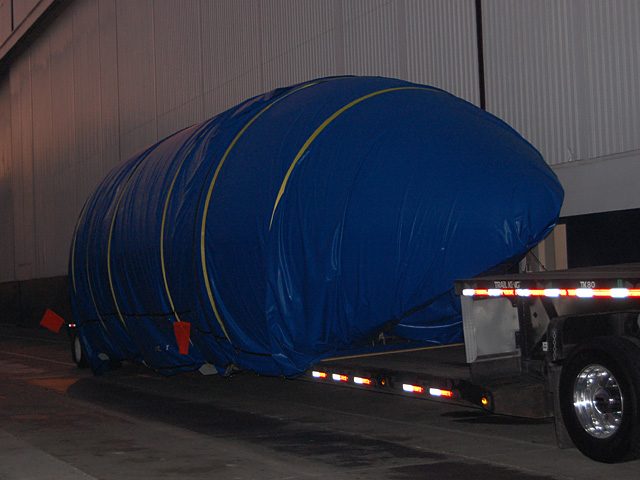
The fairing arrives on a flatbed.
The first Falcon 9 payload fairing half arrives at SpaceX on a flatbed truck.Photo: SpaceX, mailing-list update, November 18, 2008
SpaceX mailing listNovember 18, 2008
Today, the payload fairing half for our first Falcon 9 arrived at the SpaceX headquarters via a flatbed truck.
In mid-November, before any hardware arrives, Brian Mosdell, SpaceX’s Florida launch director, walks The Space Show across Complex 40: “This is where the Falcon 9 will roll out, pin into the launch mount and rotate vertical, and then be loaded and launched.” The stages will arrive “in the second week of December,” and be processed “on the hangar slab,” open to the weather. First launch? “June of next year.”
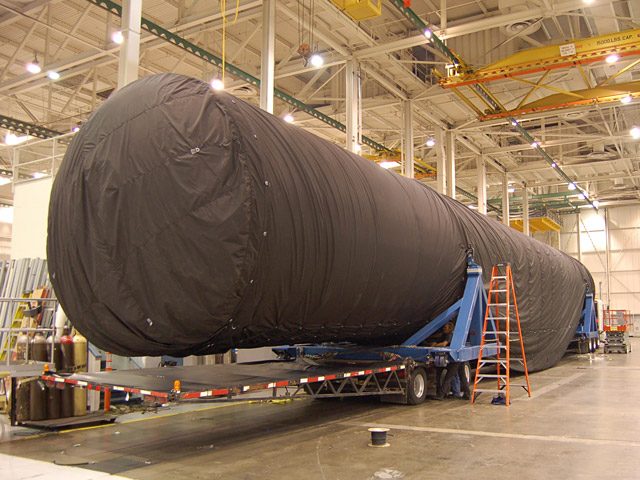
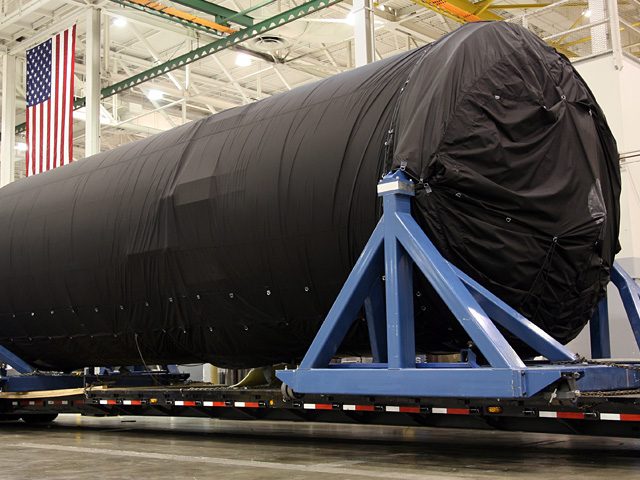
F9 1st stage tank being wrapped in preparation for shipment to the Cape.Photo: SpaceX, mailing-list update, December 3, 2008
SpaceX mailing listDecember 3, 2008
At 87 feet long, the first stage tank will travel by flatbed truck on Thursday to arrive at the Cape in mid-December. In preparation for the trip, we wrapped the F9 1st stage tank with a custom fit tarp to protect it on the road.
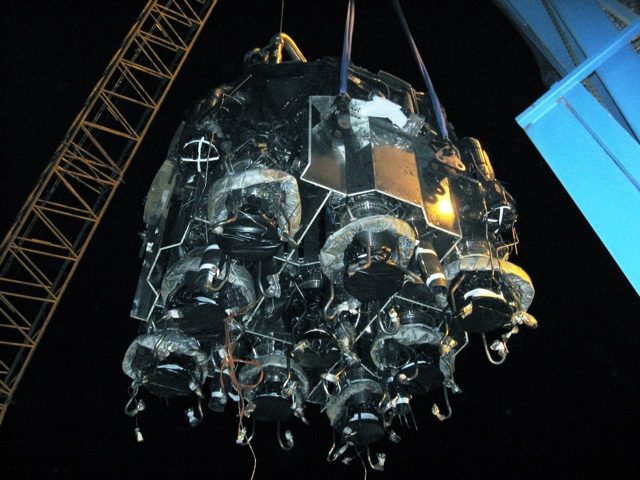
Thrust structure with nine Merlin engines.Photo: SpaceX, mailing-list update, December 4, 2008
In McGregor, wind stops the crew from setting the engines down, and all nine hang from “the second-largest crane in Texas” through the night.
Berger, Reentry, ch. 2
“All of SpaceX was hanging in there from a crane in front of me.”
Roger Carlson, test engineer. Quoted in Berger, Reentry, ch. 2, 2024.
SpaceX mailing listDecember 4, 2008
High winds prevented our team from climbing the vertical test stand (over 100ft tall) to begin the project. However, the winds calmed down on Thursday and we removed both the tank and engine assembly.
Combined interstage / Merlin Vacuum engine / second stage structure is wrapped and ready for the road.Photo: SpaceX, mailing-list update, December 15, 2008
SpaceX mailing listDecember 15, 2008
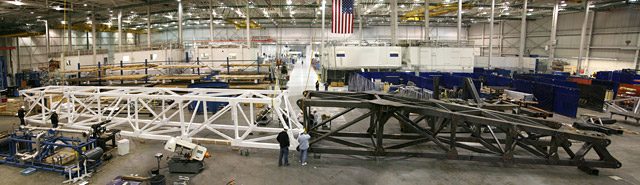
The last of the assemblies leaves the Hawthorne headquarters on a rainy day in Los Angeles. In total, we have twelve trucks heading to the Cape with the rocket and supporting parts.
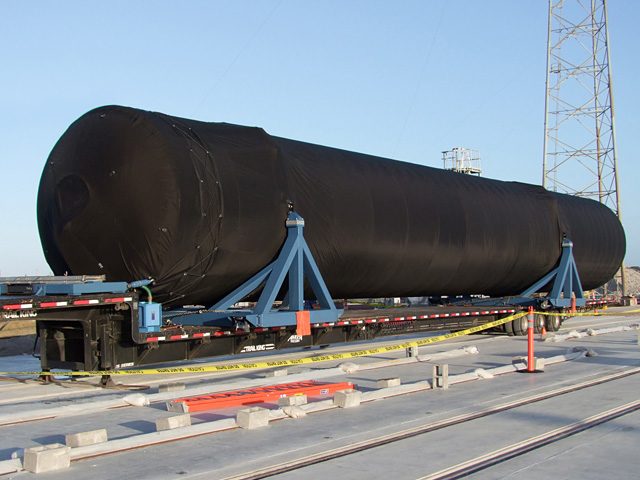
Daytime view of Falcon 9 first stage flight propellant tank at the Cape.Photo: SpaceX, mailing-list update, December 16, 2008
SpaceX mailing listDecember 16, 2008
The Falcon 9 first stage flight propellant tank arrived Tuesday night at Cape Canaveral, Florida, after its cross-country journey from Los Angeles. The tank measures 87 feet long and 12 feet in diameter — approximately the size of a 737 fuselage.
SpaceX posted an update almost every day. Read in order, they show a company building a rocket with nine engines where Falcon 1 had one, while NASA weighed its choice.
21
December 18
President
NASA would announce its choice before Christmas.
Via SatelliteDecember 18, 2008
SpaceX Names New President
Space Exploration Technologies Corp. (SpaceX) has appointed Gwynne Shotwell president, the company announced Dec. 18.
Shotwell ran sales and led the NASA bids. Musk made her president five days before NASA announced its choice.
“When Elon asked me to be President in 2008, I almost didn’t say yes.”
Gwynne Shotwell, vice president of business development, then president. Stanford GSB, 2022.
22
December 22 to 23
Day 143
The call
NASA was choosing who would carry cargo to the space station after the Shuttle retired. It announced its choice on December 23.
“I remember waking up the Sunday before Christmas in 2008, and thinking to myself, ‘Man, I never thought I was someone who could ever be capable of a nervous breakdown,’ but I felt, ‘This is the closest I’ve ever come.’” … “NASA called and told us that we’d won a $1.5 billion contract. And I couldn’t even hold the phone, I just blurted out, ‘I love you guys.’”
Elon Musk, CEO and CTO. 60 Minutes, 2014.
Musk on 60 Minutes, 2014, at 8:24. He says $1.5 billion; the record says $1.6 billion.CBS News, 60 Minutes, March 30, 2014. Watch it on YouTube
Kimbal, asked if his brother was broke:
“Oh yeah. In debt. More than broke.”
Kimbal Musk, board member and brother. 60 Minutes, 2014.
Bill Gerstenmaier made the call on Monday, December 22.
Berger, Liftoff, ch. 11
Musk changed his computer password to “ilovenasa.”
Isaacson, Elon Musk, ch. 30
In Boulder he cried, and the only Christmas present he could find was a set of see-no-evil monkey trinkets.
Vance, Elon Musk, ch. 8
SpaceX mailing listDecember 23, 2008
Big news today was SpaceX winning the NASA CRS contract for an initial $1.6 billion, representing 12 flights to the International Space Station starting in 2010. The team here worked extremely hard to make this happen and we couldn’t be more excited about not only our future, but the future of commercial spaceflight in the US and the impact this will have on our long-term efforts towards human space exploration.
WASHINGTON — NASA is gambling up to $3.5 billion on two up-and-coming rocket companies in the hopes they can provide the international space station with food and supplies after the space shuttle’s planned retirement in 2010.
Twelve cargo flights to the space station, $1.6 billion. 143 days after the third failure, NASA bet on SpaceX. The next morning a Florida paper called them rookies.
23
Christmas
On the slab
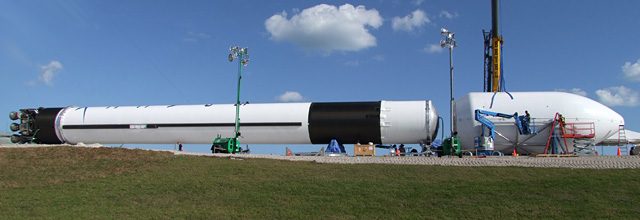
At the Cape, the parts that had crossed the country lay on a concrete slab.
SpaceX mailing listDecember 29, 2008
Side view of the entire assembly (from left) engines, skirt, first stage tank, interstage, second stage and 5.2 meter payload fairing.Photo: SpaceX, mailing-list update, December 29, 2008
Falcon 9 Assembly
The integration of Falcon 9 continued steadily through the long Christmas holiday, and the images below show just how close Falcon 9 is to being completely integrated. Whether measured by weight or by cost, the majority of the Falcon 9 being assembled is actual flight hardware.
After a very smooth vehicle mating operation yesterday, we began the process of raising Falcon 9 at 12:45pm EST and approximately 30 minutes later, Falcon 9 was vertical at the Cape.
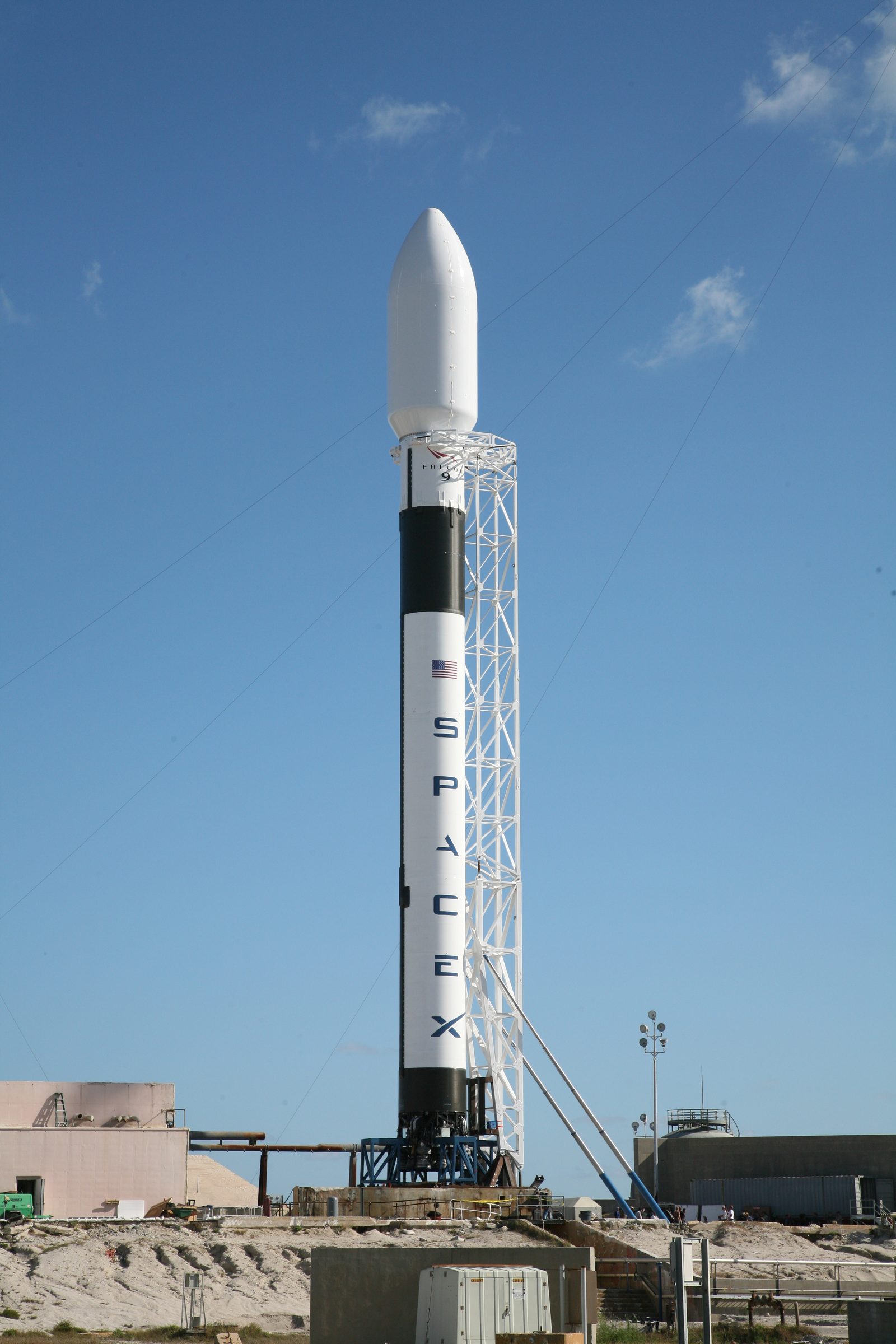
Falcon 9 on the pad at Complex 40.Photo: SpaceX, 2008 media kit
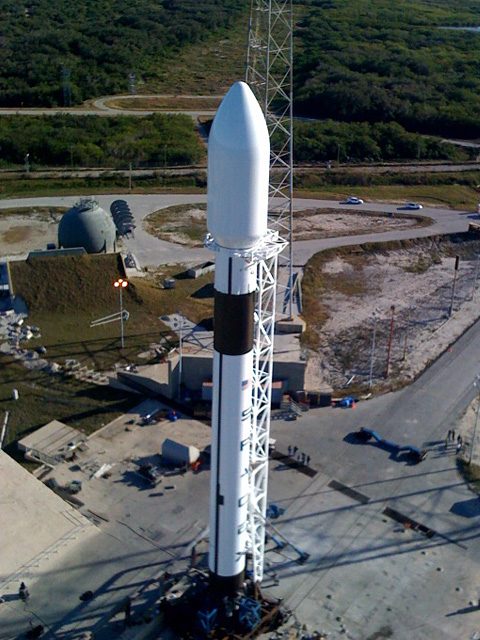
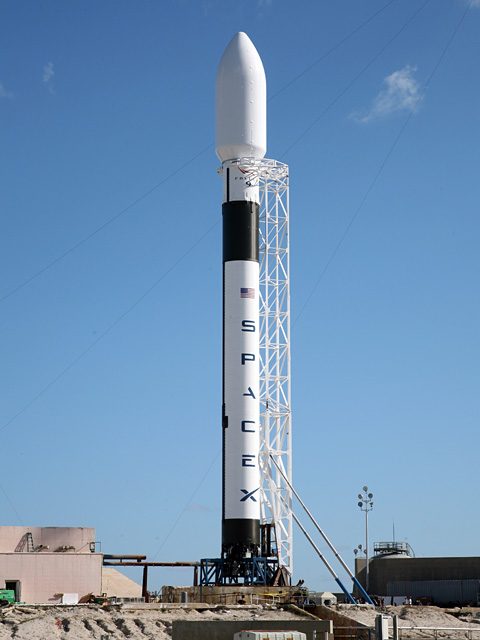
From SpaceX’s update the same day.Photo: SpaceX, mailing-list update, January 10, 2009Falcon 9 vertical at Complex 40, January 10, 2009.Photo: SpaceX, mailing-list update, January 10, 2009
“And there it stood, basking in the Florida sunshine, a beastly beauty.” Roger Carlson, the test engineer from the crane night, climbed a lightning tower and texted Musk a picture from the top: “It is pretty damn wild and scary up on top of those candlesticks, but it was one of the greatest days of my life.”
Berger, Reentry, ch. 2
The secret
“The first stage and its nine engines were real enough, but the rocket had almost none of the flight computers and other avionics needed for flight. The second stage was mostly hollow. … about half of the rocket displayed in Florida was fake.” The team called it Capricorn One, after the 1978 film about a faked Mars landing. A guard at the pad said SpaceX should fly one first.
Berger, Reentry, ch. 2
The truth at the podium
Monday, January 12, at the Cape. Buzza, Brian Mosdell and Chris Thompson take questions with the rocket standing nearby. (Berger puts Musk there too; the press quoted only his written statement.) A reporter asks what comes next.
Spaceflight Now
January 12, 2009
New SpaceX Falcon 9 rocket tests its Cape Canaveral pad
By Stephen Clark
“It has some more paces to go through. This rocket will come down, it will be disassembled, and then pieces will go back to either test sites or Hawthorne, get into final configuration for flight, and then be returned for the first flight sequence.”
Buzza adds: “I certainly don’t hope to give the impression we’re overconfident.” Thompson, beside him: “Every piece of hardware on that vehicle is essentially a flight or qualification article.”
“Elon was not happy about that, so he and I agreed that was my last press conference.” Buzza, to Berger.
Berger, Reentry, ch. 2
The record
“Every piece of hardware on that vehicle is essentially a flight or qualification article.”
Chris Thompson, vice president of structures, to Spaceflight Now, January 12, 2009
The books
“about half of the rocket … was fake.”
Berger, Reentry, ch. 2
Falcon 9 first flew 17 months later, on June 4, 2010.
Falcon 9 on the pad at Complex 40, after dark.Photo: SpaceX, mailing-list update, January 11, 2009
“He ordered large floodlights delivered to the site, and the company’s communications director, Roger Gilbertson, spent hours arranging them for dramatic shots after dark. One of the resulting nighttime images captured the beams forming a large X across the rocket.” … “But Musk was all about the show.”
Berger, Reentry, ch. 2
161 days after Flight 3 failed, Falcon 9 stood on its pad at Cape Canaveral. Half of it was a mock-up, built to show NASA, and the world, how fast SpaceX could move. The real one flew 17 months later.
The way out
“I don’t ever give up. I mean, I’d have to be dead or completely incapacitated.”
Elon Musk, CEO and CTO. 60 Minutes, March 18, 2012. Asked whether he thought of quitting after the third failure.