COTS Demonstration Flight 1
Since the successful inaugural launch of Falcon 9 in June, we have been busy preparing for our next launch, which includes the first flight of an operational Dragon spacecraft.
This is also the first launch under NASA’s Commercial Orbital Transportation Services (COTS) program. Under COTS, NASA is partnering with commercial companies like SpaceX to develop and demonstrate space transportation capabilities.
The upcoming demonstration mission will launch from Cape Canaveral and should follow a flight plan nearly identical to the first Falcon 9 launch, but this time the Dragon spacecraft will separate from the second stage and will demonstrate operational communications, navigation, maneuvering and reentry. Although it does not have wings like Shuttle, the Dragon spacecraft is controlled throughout reentry by the onboard Draco thrusters which enable the spacecraft to touchdown at a very precise location — ultimately within a few hundred yards of its target.
While Dragon will initially make water landings, over the long term, Dragon will be landing on land. For this first demo flight, Dragon will make multiple orbits of the Earth as we test all of its systems, and will then fire its thrusters to begin reentry, returning to Earth for a Pacific Ocean splashdown off the coast of Southern California. The entire mission should last around four hours.
As you may have heard, Congress just recently passed the NASA Authorization Act of 2010, setting a new direction for human space exploration. The U.S. House of Representatives voted overwhelmingly to authorize funding for a robust and viable U.S. space program. This is a critical step forward, which will allow America to continue to lead the way in space exploration.
The bill sets NASA on an exciting course to focus on exploration beyond low-Earth orbit, while recognizing the valuable role American companies are ready to undertake in ending our reliance on Russia to carry our astronauts to the International Space Station.
Investing in commercial crew transport will build on NASA’s proud record of innovation and will create competition that will force companies to improve reliability, increase safety, and reduce costs. As we move forward with our first demo flight under the COTS program, we look forward to helping jumpstart America’s space program and secure our leadership position in space.
—Elon—
FALCON 9 / DRAGON WET DRESS REHEARSAL
On September 15th we completed a successful wet dress rehearsal (WDR) which involved rolling the rocket out to the pad, loading it with propellants, performing a complete launch countdown sequence to just before ignition, and then unloading the propellants and returning the vehicle to a safe state. This latest wet dress rehearsal included new steps and sequences necessary to accommodate the operational Dragon spacecraft.
Prior to the successful WDR, we completed our first integration of a Falcon 9 and an operational Dragon spacecraft. We integrate Falcon 9 and Dragon horizontally in the hangar. This makes payload processing easier, and also eliminates the large expense of building and maintaining a vertical mobile service tower.
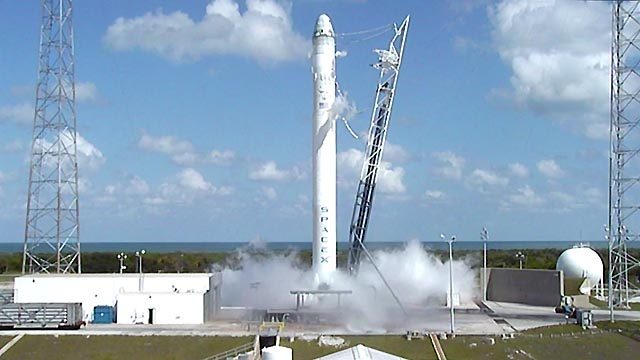
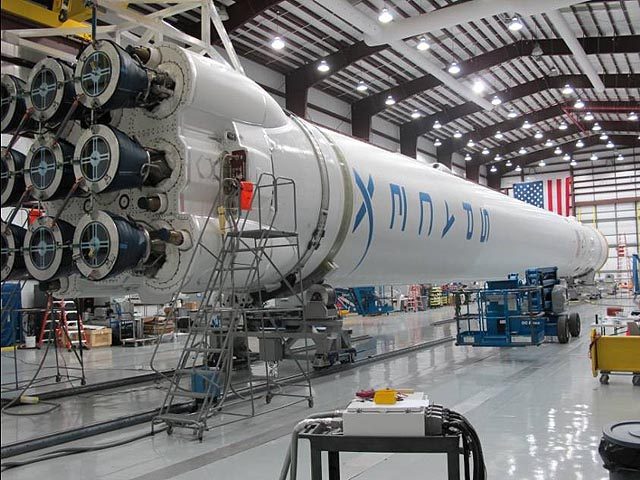
With integration complete, we transfer the Falcon 9/Dragon vehicle to our mobile transporter erector and roll it out of the hangar to the launch pad on standard railroad tracks. There, we connect the entire system to the launch pad, and rotate it to vertical.
In the coming weeks we will conduct a static test firing, which involves a full countdown leading up to the engines firing as they would for launch, but with the rocket held firmly to the pad. The following update covers some of the major progress in the past months towards this second demonstration flight.
FALCON 9 DEMONSTRATION FLIGHT 2 PAYLOAD — COTS “C1” DRAGON SPACECRAFT
Designed to transport several tons of cargo or a crew of seven astronauts to and from Earth orbit, Dragon is physically smaller than Falcon 9, but represents almost the same scale of technological difficulty.
Creating Dragon involved solving numerous design challenges, and the results are a serious space vehicle including eighteen high-performance Draco engines, hypergolic fuel systems, complex avionics, power, software, structures, guidance navigation and control systems, radio communications systems, the largest PICA-based heat shield yet to fly, and a dual-redundant deployment system for a trio of recovery parachutes.
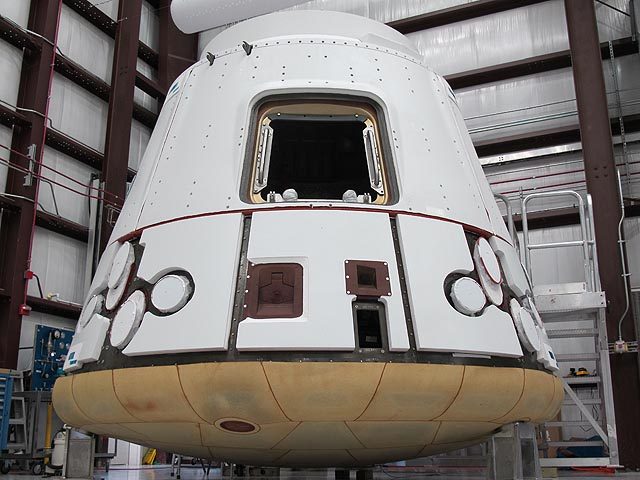
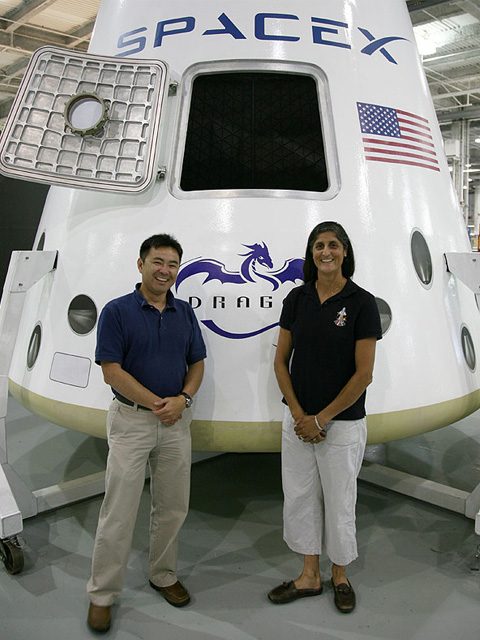
In the SpaceX hangar at Cape Canaveral, the Dragon spacecraft prepares for integration with the Falcon 9 launch vehicle. Visible at the base of the spacecraft is Dragon’s heat shield, made of PICA-X, the SpaceX manufactured variation on NASA’s Phenolic Impregnated Carbon Ablator (PICA) heat shield material. Dragon will reenter the Earth’s atmosphere at around 7 kilometers per second (15,660 miles per hour), heating the exterior up to 1850 degrees Celsius. However, just a few inches of the PICA-X material will keep the interior of the spacecraft at a comfortable temperature.
PREPARING FOR DRAGON MISSION OPERATIONS
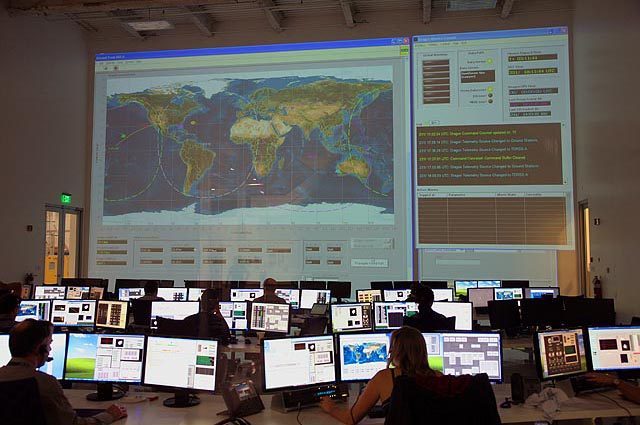
In our Hawthorne Mission Control Center, we have conducted numerous flight simulation tests in preparation for Dragon operations. Depending on the needs of a test, we can conduct live operations with NASA mission control, and even the ISS.
ASTRONAUTS TRAINING FOR DRAGON
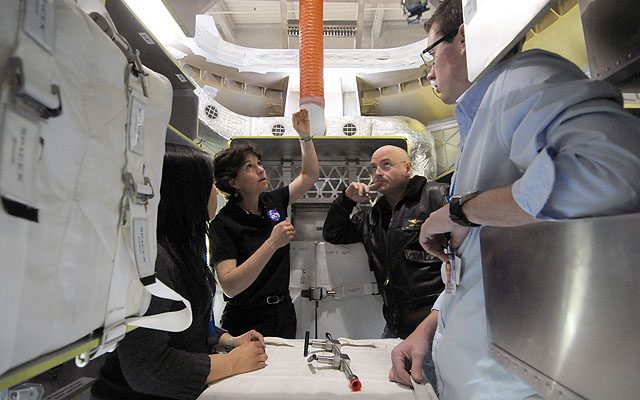
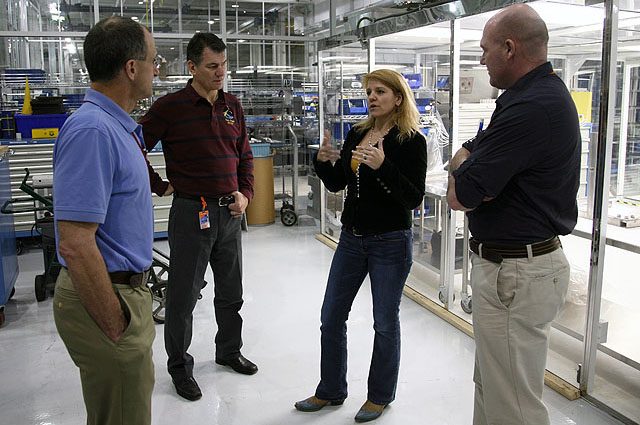
In preparation for Dragon missions arriving at the ISS under NASA’s COTS and Commercial Resupply Services (CRS) programs, we have hosted more than a dozen astronauts from NASA and international partners to date, including Italy, Netherlands, and Japan.
The training sessions work in both directions; we give astronauts hands-on experience with all aspects of Dragon operations, and SpaceX team members receive valuable insights into the fine points of living and working in space, and important feedback to incorporate into our designs and operational planning.
As part of our participation in the COTS program, we outfitted the interior of the second production Dragon spacecraft with lockers, racks and restraints as will be used for transporting cargo deliveries to and from the ISS.
We are thrilled to support the USA’s continuing human spaceflight program and the full utilization of the ISS.
CONTINUING PRODUCTION — FALCON 9 FLIGHT 3
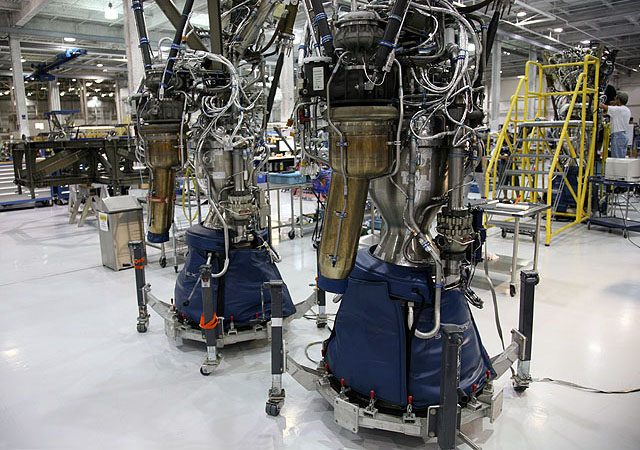
Progress continues on the third Falcon 9 vehicle, as well as the next Dragon spacecraft, both of which will fly for NASA in the coming months. We have the first and second stage tanks in process, Merlin engines being completed and test fired, and the Dragon spacecraft under way.
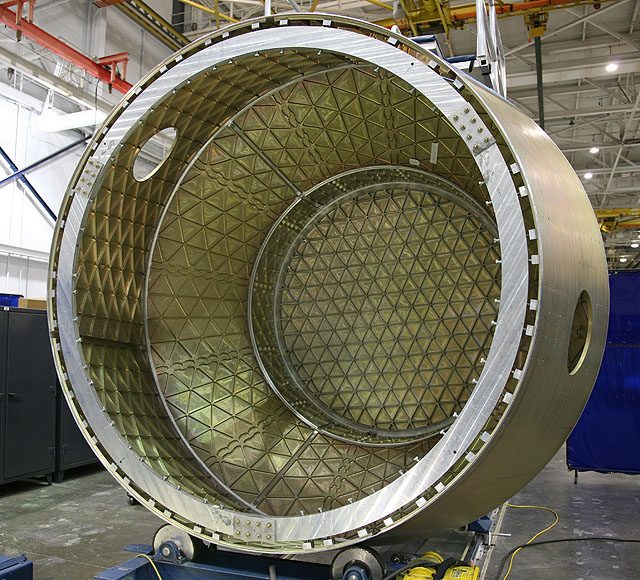
GROWING SPACEX
Our SpaceX team continues to grow, and we passed the 1,100 mark — not including this past summer’s crop of 67 visiting interns. Check out a recent editorial in Aviation Week magazine by Thomas H. Zurbuchen entitled “Aerospace Must Revive Its Spirit” which has some great things to say about the SpaceX team and program.
With more than 40 missions represented on our launch manifest, we have openings for a wide range of positions. We continue to hire the most sought-after and enterprising engineers and production technicians to help make access to space regular, cost-effective and reliable.
If you would like to join our efforts in California, Texas, or Florida, please visit our Careers page.
Come and See Us in Washington DC — October 23-24, 2010
SpaceX will be exhibiting at the national “USA Science and Engineering Festival” this fall. This is looking to be the largest event of its kind ever in the US, and we are planning fun opportunities for space fans of all ages.
If you will be in the DC area during the fourth weekend of October, please stop by our booth #333 on the National Mall, not far from the Smithsonian Air and Space Museum, and see SpaceX close up.