Dragon Drop Test
SpaceX recently completed its first Dragon high altitude drop test and it was 100% successful!
The purpose of the test was to validate the Dragon’s parachute deployment systems and recovery operations prior to the first flight of an operational Dragon later this year. The drop occurred on August 12, 2010 about nine miles off the coast from the scenic town of Morro Bay, CA—45 miles north of Vandenberg Air Force Base.
An Erickson S-64F Air-Crane helicopter dropped a test article of the Dragon spacecraft from a distance of 14,000 feet, directly above the center of a 6 mile diameter Pacific Ocean test zone.
In a carefully timed sequence of events, dual redundant drogue parachutes deployed first to stabilize and slow the spacecraft. Full deployment of the drogues then triggered the release of the main parachutes, with the drogues detaching from the spacecraft, allowing the main parachutes to deploy.
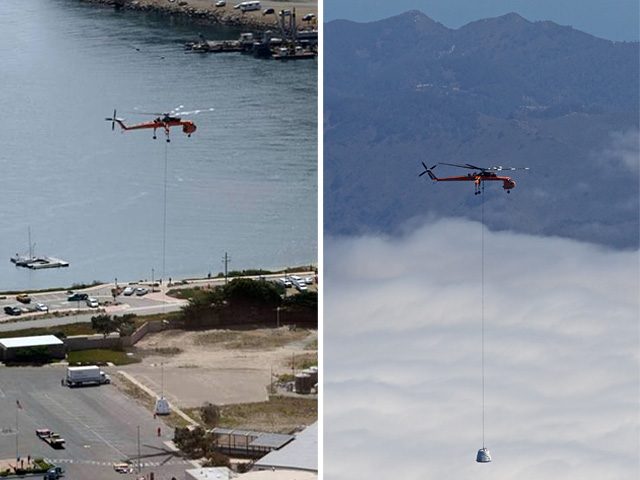
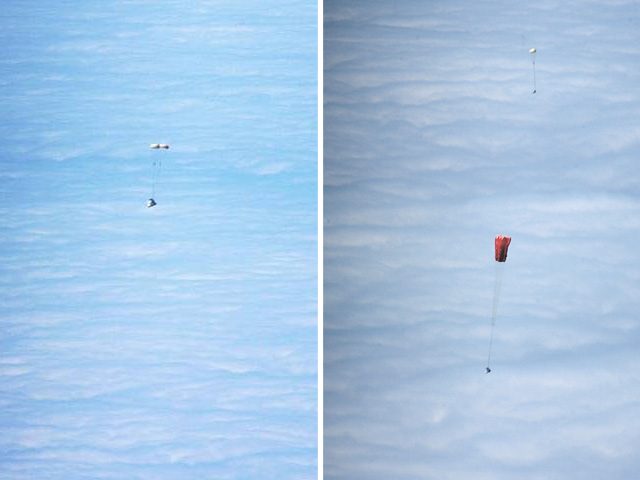
While Dragon will initially be used to transport cargo, the spacecraft was designed to transport crew. The parachute system validated during the drop test is the same system that would be used on a crew-carrying Dragon.
The three main parachutes, designed and manufactured by Airborne Systems, are particularly large—each measuring 116 feet in diameter when fully deployed. The oversized parachutes are key in ensuring a comfortable landing for crew members. After the drogues stabilize the spacecraft, the main parachutes further slow the spacecraft’s descend to approximately 16-18 ft/sec, which makes for a very soft landing.
Even if Dragon were to lose one of its main parachutes, the two remaining chutes would still ensure a pretty soft landing for the crew. Under nominal conditions, astronauts would experience no more than roughly 2-3 g’s during this type of descent—less than you’d experience at an amusement park.
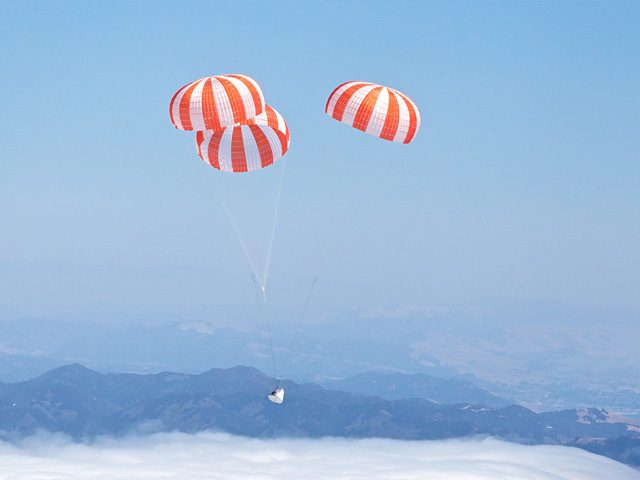
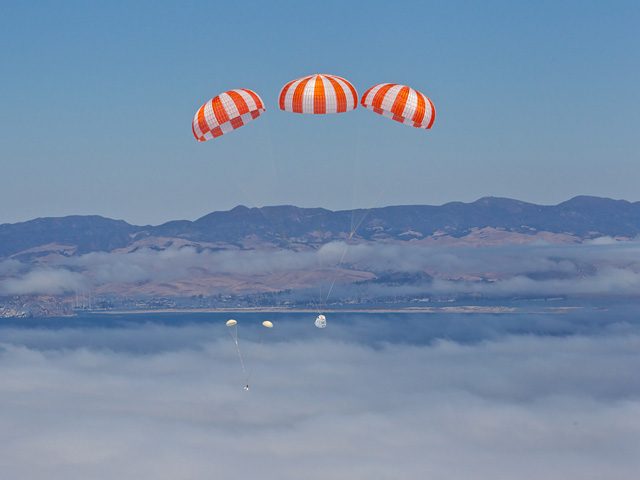
While the test article landed well within the targeted zone, the landing of an operational Dragon will be even more precise. With an operational Dragon, the landing location is controlled by firing the Draco thrusters during reentry, ensuring Dragon splashes down less than a mile from the desired landing site. Even that dispersion is only due to wind drift while Dragon is under the parachutes—if winds are low, Dragon’s landing accuracy will be to within a few hundred feet.
For initial crewed flights, Dragon will be recovered by helicopter and airlifted to shore. Our long term goal, however, is to land Dragon on land. Once we have proven our ability to control reentry accurately, we intend to add deployable landing gear and leverage the thrusters in order to land on land in the future.
During this particular drop test operation, Dragon was returned by boat and lifted onto its transport carrier via a bay-side crane as shown in the photographs below.
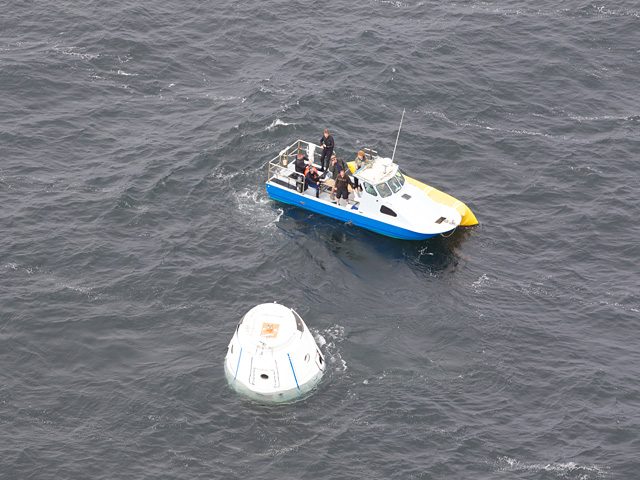
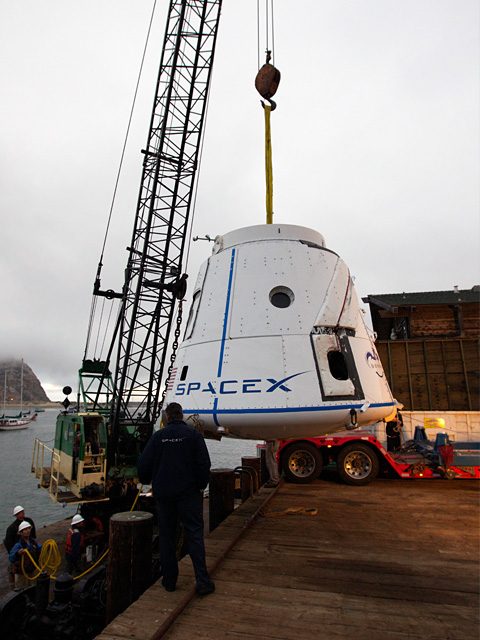
A drop test is historically a very difficult test to complete successfully, so congratulations to the entire Dragon drop team for achieving 100% success on their first attempt. In addition, SpaceX thanks the numerous individuals who were incredibly helpful in assisting with the execution of this test—a test of this size requires a concerted effort of coordination between numerous parties and we greatly appreciate their help. In particular, SpaceX thanks the Dynegy Morro Bay Power Plant, Erickson Air-Crane, Angel City Air Aerial Photography, Associated Pacific Constructors of Morro Bay, Castagnola Tug Service, Morro Bay Harbor, Fire and Police Departments, US Coast Guard Morro Bay Station, The Federal Aviation Administration, Morro Bay Planning Division, Protech Express Towing, SloDivers, Centurion Private Security, Coast Diving Service, PCF Aviation and Woody Wordsworth at Radio Shack Morro Bay.
SpaceX Team
In a recent editorial for Aviation Week, Thomas H. Zurbuchen, a professor of space science and aerospace engineering, and associate dean of entrepreneurial programs at the University of Michigan, wrote a great piece entitled “Aerospace Must Revive Its Spirit”. The article highlighted the need for entrepreneurship in aerospace, and had great things to say about the SpaceX team and our program:
“I recently performed an analysis of the very best students in my space engineering programs over the past decade, based on their scholarly, leadership and entrepreneurial performance at Michigan. To my amazement, I found that of my top 10 students, five work at SpaceX. No other company or lab has attracted more than two of these top students.
…A former student told me, “This is a place where I am the limiting factor, not my work environment”. At SpaceX, he considers himself to be in an entrepreneurial environment in which great young people collaborate to do amazing things. He never felt like this in his previous job with an aerospace company.
…Today, the SpaceX parking lots are full at night, not because people are forced to put in extra hours, but just like at the early NASA, SpaceX is working in young teams, on the toughest challenges, and realizing that risk is an important aspect of any entrepreneurial activity. That’s why SpaceX attracts the best of the best to join its team.
…I hope entrepreneurial successes, such as the ones at SpaceX, will start to define a new image for an industry that often believes its most important achievements are in the past. We need to create an entrepreneurial environment to attract top talent and once again shoot for the stars!”
Hiring top talent has always been a number one priority for SpaceX. Our team now numbers over 1,200 and we continue to seek out the most sought-after and enterprising engineers and production technicians in the industry. If you or someone you know is interested in joining our team, please visit our careers webpage at www.spacex.com/careers or email us at [email protected].