The new launch date is approximately December 20, depending on when the Missile Defense Agency testing is complete. As soon as we have a firm time, it will be posted on the SpaceX website.
Liquid Oxygen
Regarding liquid oxygen (LOX) supplies, we expect to have enough on hand this time to fill the rocket four or five times over. This should account for almost any issue with a particular storage tank as well as an extended hold on the pad. There is an engineering term known as a s*load. I have asked that we have at least two s*loads on hand in case one s*load is not enough.
We chartered a C-17 to fly two of our empty high quality LOX containers to Hawaii, sourced another high quality LOX container on Hawaii and put all three on the barge to Kwajalein. In addition, our LOX plant on Kwajalein has been repaired and is producing LOX on island again.
Some might be wondering why we were so dumb as to run out of LOX on a remote tropical island on the last launch attempt. Believe me, we tried hard to avoid it, but several issues conspired to create the problem:
- The additional month of Merlin testing resulted in additional LOX boil-off on island. Even though it is stored in vacuum jacketed containers, LOX at -300F degrees does not like being on a tropical island at 85F.
- The SpaceX LOX plant on island broke down a few weeks prior to launch, which meant we could not top up.
- We ordered replacement LOX from Hawaii, but the container quality was poor, so only 20% of what we ordered actually arrived.
- Ground winds were unusually high on launch day, which amplifies the boil-off rate significantly, since the Falcon’s first stage LOX tank is uninsulated.
- All of the above would not have mattered if our final storage tank did not have a small, manual vent valve incorrectly in the open position. Somewhat agonizingly, we were only a few percent away from being full. We just needed a little sip from the last tank.
- After a while, we were able to close the vent and fill the vehicle’s LOX tanks. However, we use LOX to chill our onboard helium and the absence of ground LOX to do so resulted in the helium heating up and venting back to storage. In the end, we did not have enough LOX to stay filled on the rocket and chill & pressurize the helium.
Engine Computer
The engine computer reboot anomaly was definitively traced to a ground power problem. Importantly, this would have had no effect on flight, since we switch to vehicle power before the autosequence begins. The reason it cropped up at Kwajalein was that the higher load on the longer umbilical (three times longer than in prior tests) coupled with high temperatures in Kwajalein resulted in increased resistance in the ground umbilical. This was just enough to lower the voltage below minimums and cause an engine computer reset when drawing maximum power. The same max power test was repeated on internal vehicle batteries with no problem at all.
This problem has been solved by slightly increasing voltage on the ground umbilical.
—Elon—
The SpaceX launch date is scheduled for Monday, December 19 at 11 a.m. California time (7 p.m. GMT).
All systems have passed their prelaunch checkout and we are go for launch tomorrow at 11 a.m. California time (7 p.m. GMT). Over the past month, we have also improved and upgraded the countdown sequence in several ways:
- More computer controlled operations vs manual
- Improved ground support equipment to load propellant/pressurant faster
- Worked with range safety to speed up checkout of the thrust termination system
- Changed to simultaneous load of LOX and fuel on both stages
The Vandenberg hold down firing countdown was 5 hours, the first Kwaj countdown was 4 hours and now we are at 3 hours. Having a responsive launch capability is important to DARPA and the Air Force (and us for cost reasons), so we’ve put a lot of effort into streamlining the countdown.
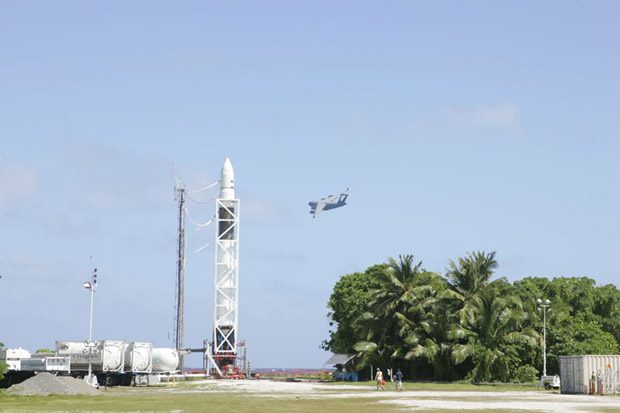
—Elon—
Launch is scrubbed until early next year, as there is a structural issue with the 1st stage fuel tank that will require repair. I will provide further comment as soon as this has been carefully analyzed.
Consistent with our policy, we must be 100% green for launch with no outstanding concerns whatsoever. It is not just a matter of repairing the damage, but also understanding at a fundamental level how to ensure it never happens again. We will also do another full review of all the vehicle systems, including propulsion, structures, avionics, software and ground support systems. Therefore, I expect that the earliest that launch would occur is late January. Third time’s the charm.
— Elon —
Here is the apparent cause of structural damage (further analysis may change the conclusion):
- Due to high winds, we placed the countdown on hold and began draining the fuel tank.
- As we drained fuel from the 1st stage tank, a faulty pressurization valve caused a vacuum condition in the tank.
- This caused a fuel tank barrel section to deform and suck inward. It is important to note that the root cause is an electrical fault with a valve, not structural design.
At this point, it appears that no other damage was sustained to the vehicle or the satellite. The rocket will be lowered down this afternoon and placed in its hangar for further inspection.
— Elon —