Jan/Feb 2004
The Final Stretch
We are now entering the final stretch before launch. A lot of work still remains, but the bulk of the development on engines, structures, avionics & guidance, regulatory matters and the mobile launch system is done.
There could still be some hidden issues that show up only at the last minute, but, notwithstanding a major setback, we are on track for a maiden launch around the middle of this year.
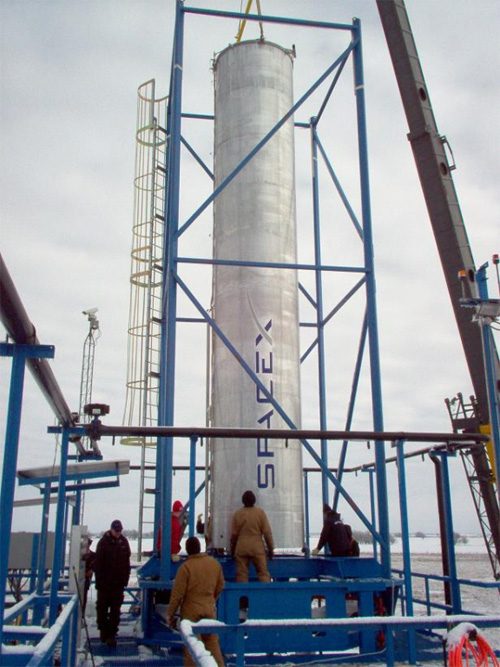
The next major milestone is the stage hold down test, which should happen in the next four to six weeks. This is where we take the complete first stage of the vehicle, with flight tanks and a fully integrated engine, through a full duration firing. As described below in the technical development update, the first stage has been fitted into the vertical test stand and is ready for the engine to be attached.
Falcon User’s Conference
Our first user’s conference will take place on March 24/25th near SpaceX HQ in El Segundo, about a mile south of LAX. This will be an opportunity for potential customers to help define a standard set of mechanical and electrical interfaces for spacecraft, as well as help set development priorities for improvements in the payload integration process and flight environment. Our aspiration is that Falcon comes to have the most customer friendly payload integration process and most benign flight environment of any launch vehicle in the world. If you would like to attend, please send an email to [Gwynne Shotwell] for an invitation to this event.
Next Year’s Launch Schedule
Interest in both Falcon I and Falcon V has been growing steadily month after month. At this point, it appears very likely that we will have at least three or four customers on contract prior to the first launch, including one or two Falcon V customers.
If all those potential customers that have expressed strong interest in a 2005 launch actually sign up, we will have a full schedule next year. Unless there is a failure along the way, I can say that at this point it seems likely we will do at least four or five launches next year.
Quality Assurance and ISO 9001
To head up our manufacturing quality assurance department, we recently hired Grant Ingram, who has spent the last several years driving QA/QC programs in the semiconductor industry for companies like Intel. There are few industries that have more stringent quality control programs than the semiconductor business, where infinitesimal impurities can cause failure. Prior to that, Grant spent nearly a decade at Boeing (McDonnell Douglas) performing QA/QC on both manned and unmanned space vehicles.
Grant will be responsible for implementing a rigorous ISO 9001 quality management system at SpaceX and ensuring that our launch vehicles are built consistently and to exacting standards every time.
Regulatory Developments
From the regulatory front, there is some good news. We received approval to fly the rocket with only thrust cutoff, rather than explosive termination. This is a really big deal and significantly improves hazardous procedures in transportation, on the launch pad and particularly on recovery of the first stage. Falcon will be the only orbital US launch vehicle to fly with thrust cutoff, which is only possible due to the all liquid fuel configuration and six-fold valve redundancy.
— Elon
TECHNICAL DEVELOPMENT UPDATES
Propulsion
Further testing is placing the Kestrel upper stage engine at a solid 96.3% combustion efficiency. This is 0.8% above our design target as it implies a 327s Isp and will provide some margin on mass to orbit performance. That said, we will maintain the official 325s Isp rating for the time being and consider the improvement as margin for the first flight. Overall, Kestrel is performing very smoothly and we are often able to do several tests per day with a slightly tweaked injector or fuel ring each time.
At the beginning of this program, we were prepared to accept below average engine performance to save cost and time. However, through the hard work & skill of the propulsion team and some good fortune, both engines are turning out to have excellent performance. We’re optimistic that both Merlin and Kestrel will be among the best in class, but will hold off conclusions until the qualification program is completely finished.
The biggest remaining question is the liquid oxygen inducer/impeller (a propeller-like device) on the Merlin turbo-pump. It is important to have significant cavitation margin and we are not quite there. What we hope will be a final revision goes to test in early March.
Structures
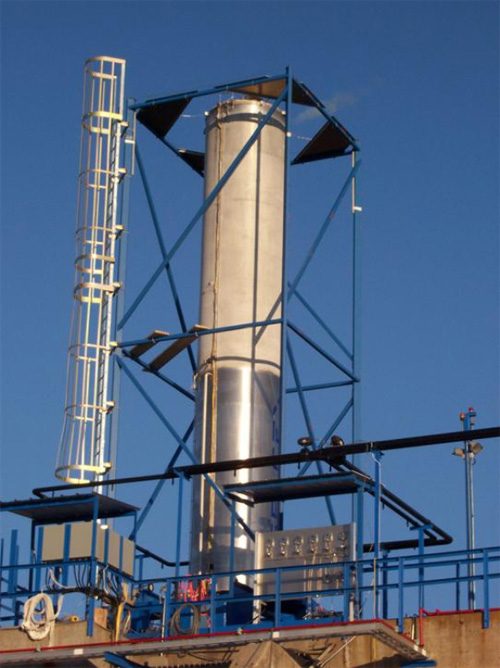
A few weeks ago, the Falcon I first stage was lifted, fitted and secured to Vertical Test Stand 1 (VTS-1) at our Texas test facility. We then remotely filled the tanks with RP-1 kerosene and liquid nitrogen. The latter was used as an inert cryogenic substitute for oxygen to protect against a worst case scenario.
Pressures were brought up to predicted max load plus 10% with no problems detected at all. Each tank has several pressure transducers for redundancy and is heavily strain gauged. Predicted stress was very close to actual measured stress, which means our FEA models are likely to be good predictors in other tests coming up.
This was a critical test of not just design and analysis, but also manufacturing, quality assurance, ground handling processes and remote fill & drain. We all breathed a collective sigh of relief when the data came back positive.
Computational Fluid Dynamics
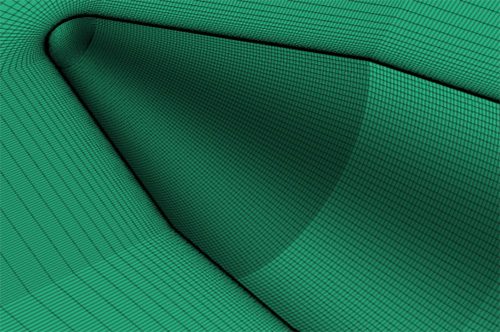
SpaceX has been steadily improving in-house computational abilities with a combination of new, commercial, and university-based CFD codes. This analysis centers on Euler and Navier-Stokes external flow solutions for pressure, temperature, turbulence, and aerodynamic heating. A variety of codes and numerical algorithms are employed as appropriate for the geometry and flow conditions, ranging from subsonic flow at sea level to high Mach number rarified gas in the upper portions of the atmosphere. The images below provide a glimpse into the procedure.
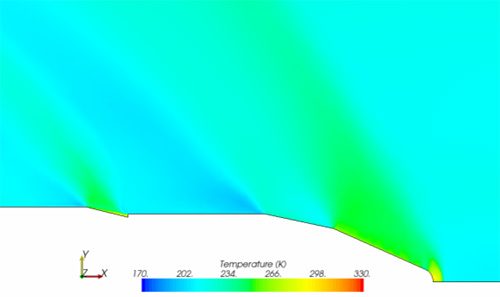
Larger 3D models on the order of several million cells have been run with the help of Stanford University’s Aerospace Computing Laboratory (ACL). As part of this collaboration, the Reynolds-Averaged Navier-Stokes flow solver is being used to determine the details of the flow field around the Falcon configuration and to extract realistic flight loads.
Calculations are typically run on a 48 processor Beowulf cluster. For launch vehicle configurations with around 2 million nodes, a steady-state solution can be obtained in less than 2 hours. This rapid turnaround allows for the analysis of multiple flight conditions and configurations during the design process.
Avionics & Flight Systems
Guidance System
We have now run our guidance & control algorithms against a six degree of freedom simulator using 1000 days of wind data from Vandenberg AFB. Under the worst wind conditions, Falcon made orbit to within 2 km every time, with most orbits far more accurate. This assumes one GPS fix on the way up at t = 200 s. For our first flight, there may be factors unaccounted for that make this significantly less accurate, but over time and assuming a good GPS signal, we should be able to make target perigee altitude to within meters.
So, at least as far as the guidance system and engine control authority are concerned, Falcon is an all weather vehicle. Unless there is a weather system with a name in the neighborhood, we can fly any day of the year out of Vandenberg. That said, we plan on ensuring it is a very nice day before pushing the launch button.
Assorted Hardware Progress
Tank pressurization, which we consider a flight system, is working very well. We use triple redundant pressure transducers and dual redundant valves in a bang-bang configuration. All the corner cases have now been tested, including obviously failure of a pressure transducer and failure of a valve. Our tests are normally scripted, with an experiment, result and conclusion. However, at one point, Tim (Director of Test Operations) intentionally stepped out of sequence and unplugged a pressure transducer feed to the flight computer, to the surprise of the avionics group. The system automatically compensated with no more than a 0.1psi drop.
Intercommunication between the avionics system is improving. We now have a high efficiency driver for the IMU (gyroscope) to flight computer interface, resulting in a very low load on the bus & CPU. Also, the vehicle wiring diagram is nearing completion and the first iteration of the whole vehicle wiring harness should be complete in the next several weeks.